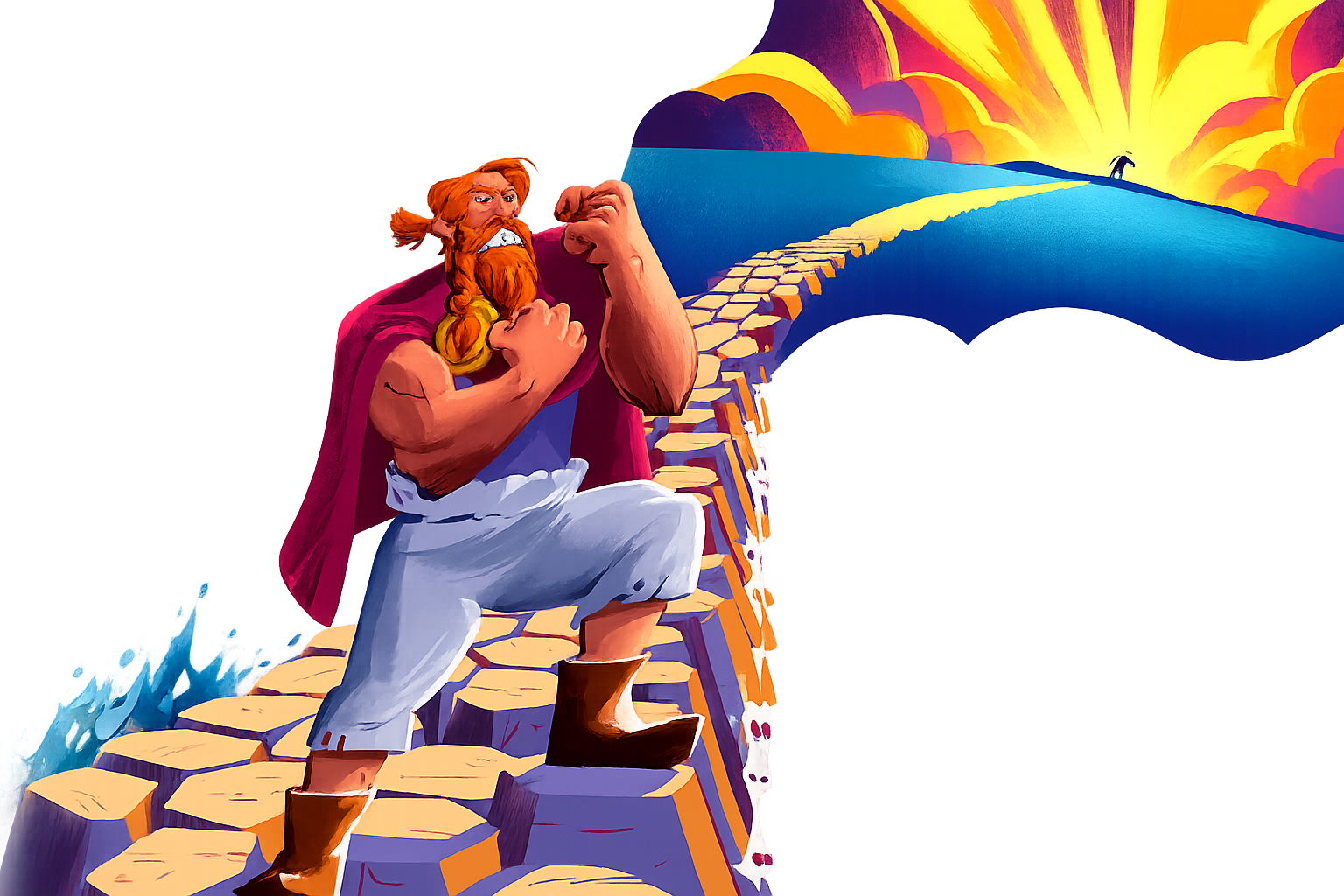
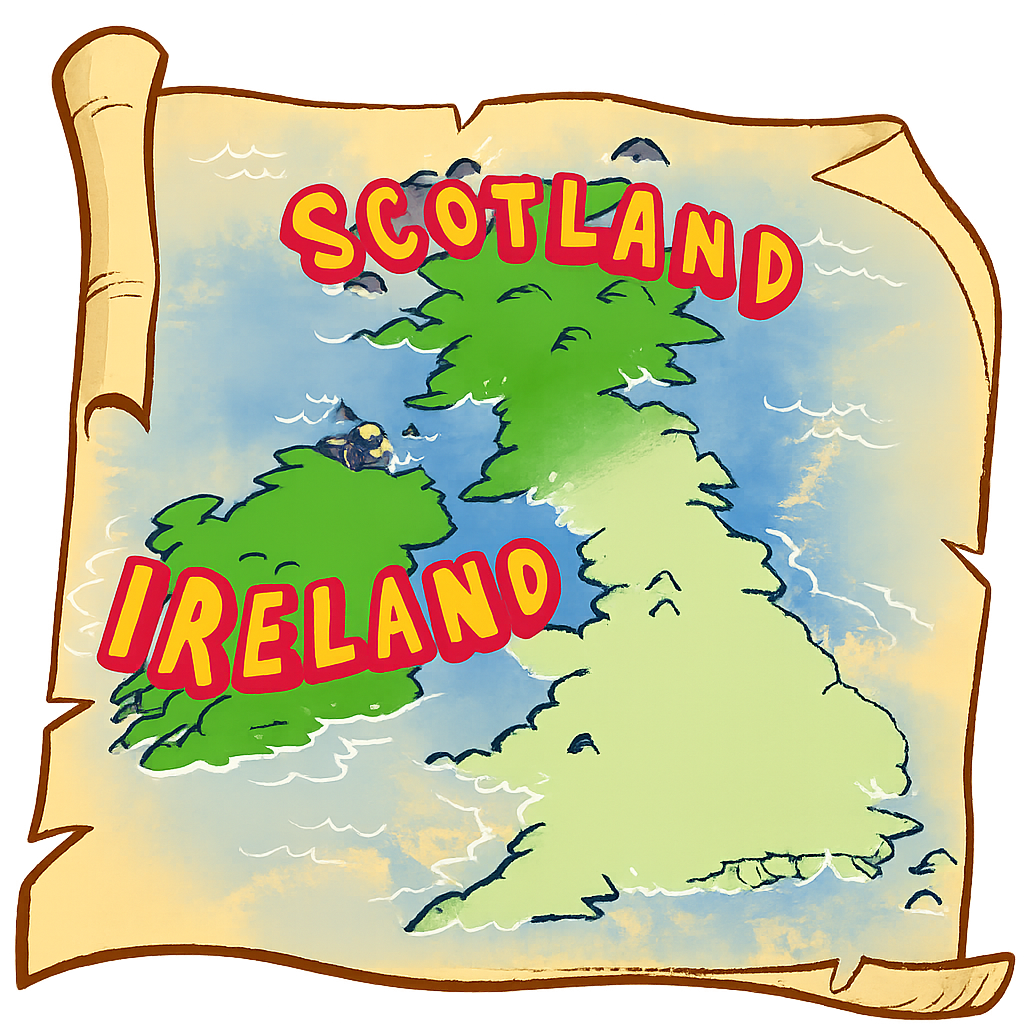
Meet the giant Finn McCool and read the beginning of his legend.
1Séances·2Documents·A1→A2CEFR
Information
Détails
Axe :
Axe 4 — Imaginaire, contes et légendes
Problématique :
Comment les légendes expliquent-elles les paysages et le monde qui nous entourent ?
Objet d'étude :
L'Irlande, terre de mythes et de légendes
CEFR :
A1 → A2
Activités langagières :
CE, CO, EO, EE
Objectifs
Objectifs linguistiques :
Le vocabulaire des personnages de légende (a hero, a giant, brave, big…) et l'ouverture « Once upon a time… ».
Objectifs culturels :
Le géant Finn McCool, la Chaussée des Géants et les légendes d'Irlande.
Objectifs communicatifs :
Anticiper à partir d'un titre et d'images, puis comprendre et résumer le début d'un récit.
Documents
Texte : The Legend of Finn McCool — Part 1
Vidéo : Reading the legend aloud
Contenu
Séance 1 : Who is Finn McCool?
Évaluation : Compréhension écrite
Séance 1 :
Who is Finn McCool?
Objectif : Anticiper le contenu d'un récit à partir de son titre et de ses illustrations, puis comprendre le début de la légende de Finn McCool.
Activités : Remue-méninges sur les légendes et l'Irlande, stratégies pour comprendre une histoire illustrée, lecture du début de la légende, anticipation à partir du titre et des images, lecture à voix haute en écho, résumé oral du récit.
À retenir : Savoir anticiper une histoire à partir d'indices visuels ; savoir repérer les personnages, les lieux et l'idée principale du début d'une légende.
Vocabulary Kit: Characters
Characters
a hero=un héros
a heroine=une héroïne
a giant=un géant
a friend=un ami
an enemy=un ennemi
an ally=un allié
brave=courageux
courageous=vaillant, courageux
intelligent=intelligent
stupid=stupide, bête
big=grand
small=petit
How to: Understand an illustrated story
Understand an illustrated story
Before you read, use everything on the page to work out what the story is about.
Look at the title and the pictures first, and predict what the story is about.
Find the main characters and the places in the illustrations.
Look for clues: names in CAPITAL letters, key words, and what the text says.
Read and listen at the same time to check your ideas.
Brainstorm: Legends and Ireland
Say what you already know about legends and about Ireland.
Dis ce que tu sais déjà sur les légendes et sur l'Irlande.
Need ideas? Think of giants, heroes, monsters, magic, islands, castles, and things from long ago.
Besoin d'idées ? Pense aux géants, aux héros, aux monstres, à la magie, aux îles, aux châteaux et à autrefois.
Your words will appear here.
Anticipation: The Legend of Finn McCool
The task
Look at the title and the pictures of the legend. What do you think the story is about? And what is a legend?
Regarde le titre et les images de la légende. À ton avis, de quoi parle l'histoire ? Et qu'est-ce qu'une légende ?
30 – 40 mots
Hints
What is a legend?+
A legend is a very old story, often about heroes, giants or magic. People have told it since long ago.
Look at the pictures+
Ask yourself: who can you see? Where are they? What are they doing?
Useful words+
a giant, a hero, brave, Ireland, a causeway, long ago…
Sentence starters+
I think this legend is about… / In the pictures, I can see… / A legend is…
Grille d'évaluation — production écrite
Marking guide — written task
… / 20
Content
Predicts what the story is about and explains what a legend is.
… / 5Contenu
Language
Uses I think…, I can see… and the present simple.
… / 5Langue
Fluency
30–40 words; the ideas connect naturally.
… / 5Aisance
Accuracy
Simple sentences are correct; vocabulary is well spelled.
… / 5Correction
Your ideas
Document: The Legend of Finn McCool
The Legend of Finn McCool and the Giant’s Causeway
— Part 1 —
____________________
_________________________
______________________________
_______________
_________________________
____________________
_____
Once, a long time ago,the worldwasvery different.In those days,a giantnamed Finn McCoollivedin Ireland.Finnwas so bigthathe was able to builda stone causewayall the way from Ireland to Scotland!Whydid he dothat?Well,he wantedto fighta Scottish giantnamed Benandonner.Butbigis not alwaysclever.To be continued …
The Legend of Finn McCool and the Giant’s Causeway — told by Rupert Morgan
*a stone road above the water
Document: The Legend of Finn McCool (read aloud)
Part 1 of the legend, read aloud by a storyteller.
La première partie de la légende, lue à voix haute par un conteur.
The Legend of Finn McCool and the Giant’s Causeway — told by Rupert Morgan
Script
____________________
_________________________
______________________________
_______________
_________________________
____________________
_____
Narrator
Once, a long time ago,the worldwasvery different.
In those days,a giantnamed Finn McCoollivedin Ireland.
Finnwas so bigthathe was able to builda stone causewayall the way from Ireland to Scotland!