Séance 1 : In Room 3: The Runaway

  • Objectif : Comprendre un audioguide sur The Runaway, décrire des sentiments et donner son avis sur une œuvre.
  • Activités : vocabulaire des émotions et des opinions, nuage de mots sur The Runaway, découverte du tableau, rappel de la stratégie d’observation, écoute de l’audioguide, légende du tableau, tâche de traduction.
  • À retenir : Savoir décrire les sentiments des personnages (he looks sad, I think he is worried) et savoir donner son avis sur une œuvre (I like it, it’s funny).

Vocabulary Kit: Describing The Runaway

The scene
  • the runaway = le fugueur
  • the little boy = le petit garçon
  • the policeman = le policier
  • the bartender = le serveur
  • a stool = un tabouret
  • the counter = le comptoir
  • the red bundle = le baluchon rouge
  • the menu = le menu
  • today's specials = les plats du jour
Emotions
  • happy = heureux
  • sad = triste
  • excited = excité(e)
  • tired = fatigué(e)
  • serious = sérieux(se)
  • angry = en colère
  • amused = amusé(e)
  • he looks… = il a l’air…
  • I think he/she is… = je pense qu’il/elle est…
Opinions
  • I like it = j’aime ça
  • I love it = j’adore ça
  • I don't like it = je n’aime pas ça
  • it's great = c’est génial
  • it's funny = c’est drôle
  • it's fantastic = c’est fantastique
  • I don't understand it = je ne comprends pas

The Runaway

Look at the title “The Runaway”. Say the words and ideas that come to mind.
Regarde le titre « The Runaway ». Dis les mots et les idées qui te viennent à l’esprit.
Your words will appear here.

Document: The Runaway

The Runaway (1958) shows a little boy with a bundle sitting at a diner counter, next to a friendly policeman.

The Runaway (1958) montre un petit garçon avec un baluchon, assis au comptoir d’un diner, à côté d’un gentil policier.

The Runaway by Norman Rockwell, 1958

Norman Rockwell, The Runaway, 1958.

How to: Observe a Painting

Look carefully, step by step

Before you describe a painting, take a moment to look at everything in it. Ask yourself these questions:

  • Composition — What can you see in the middle, on the left and on the right? What is at the top and at the bottom?
  • Characters — Who are the people? What are they wearing?
  • Place — Where are they? What can you see in the background?
  • Colours — Are the colours dark, light or bright?
  • Feelings & actions — How do the people look? What are they doing? What is happening?

Audioguide: The Runaway

The museum guide leads you into Room 3 and describes The Runaway and its imitations.

Le guide du musée vous emmène dans la salle 3 et décrit The Runaway et ses imitations.

Museum audioguide — 2’03

Script
_____ _____
_____ _____ _____ _____ _____ _____
_____ _____ _____ _____ _____
_____ _____ _____ _____
_____ _____
_____ _____ _____
_____ _____ _____
_____ _____ _____ _____ _____ _____
_____ _____ _____
_____ _____ _____
_____
_____ _____ _____ _____
_____ _____ _____
_____ _____ _____ _____ _____
_____ _____ _____
_____ _____ _____
_____
_____ _____ _____ _____
_____ _____ _____
_____ _____ _____
_____ _____ _____ _____
_____ _____ _____
_____
_____ _____
_____ _____ _____ _____ _____
_____ _____ _____ _____
_____ _____ _____ _____ _____
_____
_____ _____ _____
Guide
We're now entering Room 3.
In this room, dedicated to imitations and homages, you can see how Norman Rockwell influenced other artists.
Rockwell's paintings are so famous that there are many imitations, usually quite funny.
Here for example, you can see the original painting and two pastiches.
Can you spot the original?
… Yes! It's the one on the left.
You can see the name of the artist, Norman Rockwell.
In this painting, we can see a policeman and a little boy sitting on a stool in a diner.
A diner is a type of restaurant in the USA.
In the background you can see what's on the menu.
Look closely…
Yes! Today's special is spaghetti and meatballs, a classic!
The three people are looking at each other.
The policeman is wearing his uniform and the little boy is wearing jeans and a yellow T-shirt.
Behind the counter, the bartender is looking at them.
He is smoking a cigarette and he is smiling.
He seems amused.
The policeman is looking at the little boy, he seems curious.
Can you see what's on the floor, next to the boy's stool?
Look closely… it's a little red bundle.
Can you imagine what the little boy is carrying in this bundle?
Maybe it's some clothes and his favorite toys.
What do you think?
Let's imagine what happened…
Maybe he was not happy with his parents and decided to leave home.
So maybe he's a "runaway", that's the title of the painting.
Can you imagine what the little boy, the policeman and the bartender are talking about?
Now it's your turn!
Look at the imitations: which one is your favorite?

Writing Task: Label The Runaway

The task
Look at The Runaway. Write the words you understand to label the picture. Then write two or three sentences to say what is happening.
Regarde The Runaway. Écris les mots que tu comprends pour légender l’image. Puis écris deux ou trois phrases pour dire ce qui se passe.
Labels + 2–3 sentences
Hints
Labels +
Useful words: a stool, the counter, the little red bundle, the menu, today’s specials.
Who? +
The people: a policeman, the little boy (the runaway), the bartender.
Actions (BE + V-ing) +
Say what they are doing: The boy is sitting. The bartender is smiling.
Feelings +
How do they feel? curious, amused, worried, serious.
Grille d'évaluation — production écrite
Marking guide — written task
… / 20
Content
The main elements of the painting are labelled.
… / 5Contenu
Language
BE + V-ing used to describe the actions.
… / 5Langue
Fluency
Two or three clear sentences.
… / 5Aisance
Accuracy
Correct spelling of the labels and -ing forms.
… / 5Correction
Your answer

Translation Task: Feelings & Opinions

Build the sentence in English
Clique sur une flèche pour lancer la roulette.

Séance 2 : Rockwell Revisited

  • Objectif : Découvrir ce qu’est un pastiche, comparer The Runaway à ses réinterprétations et imaginer une histoire.
  • Activités : définition d’un pastiche, découverte de deux imitations de The Runaway, similitudes et différences (but, whereas, both), tâches orales pour raconter l’histoire du tableau, mots croisés des personnages et actions, tâche de traduction.
  • À retenir : Savoir comparer deux œuvres (both, but, whereas) et savoir raconter ce qui se passe dans un tableau avec BE + V-ing.

Document: Spider-Man

This is a modern pastiche of The Runaway. Here, Spider-Man takes the place of the little boy at the diner counter.

Voici un pastiche moderne de The Runaway. Ici, Spider-Man prend la place du petit garçon au comptoir du diner.
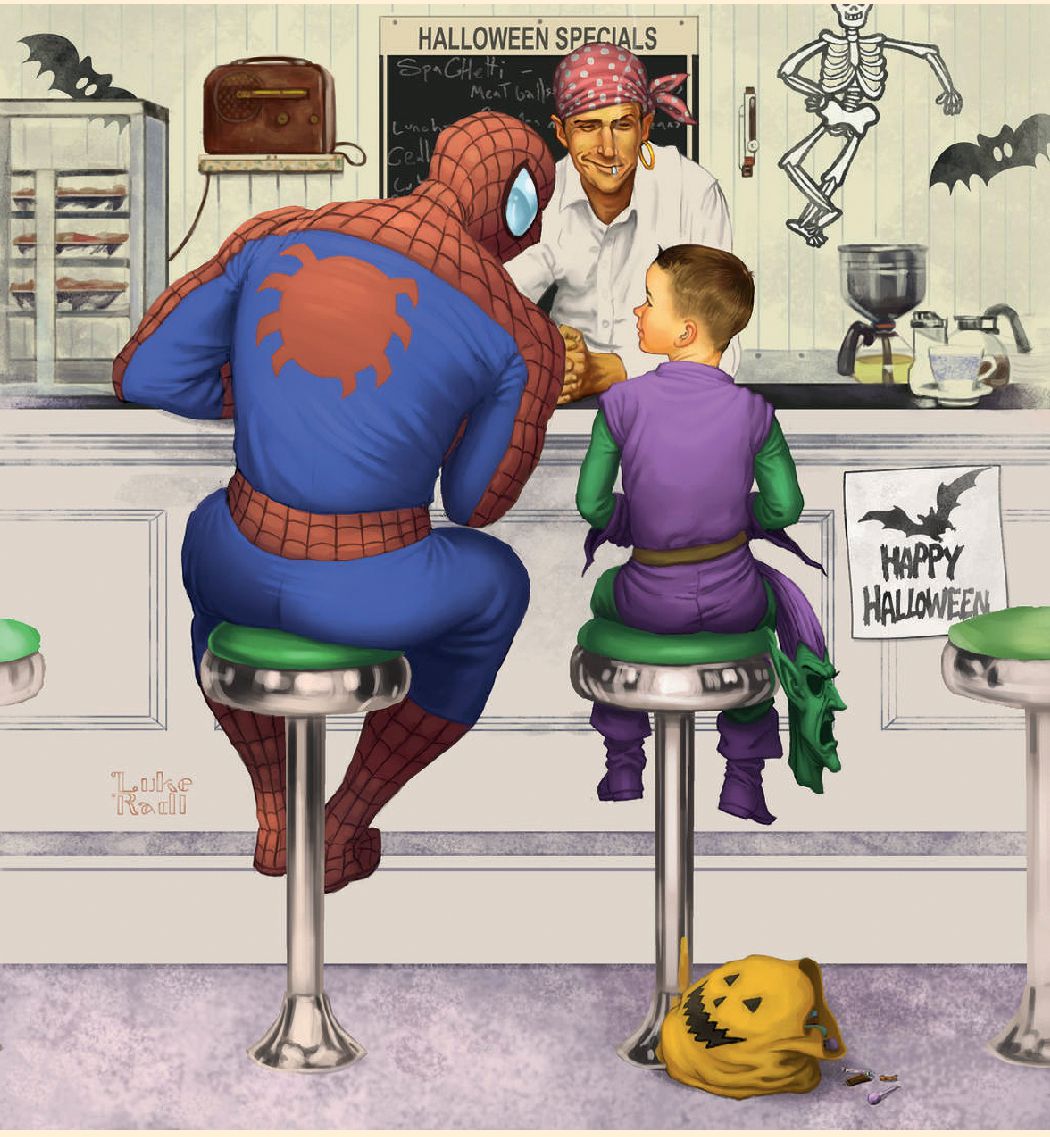
Rockwell Spiderman by Lukeradl, 2009

Lukeradl, Rockwell Spiderman, 2009.

Document: The Incredible Hulk

This is another pastiche of The Runaway — a comic-book cover in which the Incredible Hulk replaces the little boy.

Voici un autre pastiche de The Runaway — une couverture de bande dessinée où l’Incroyable Hulk remplace le petit garçon.
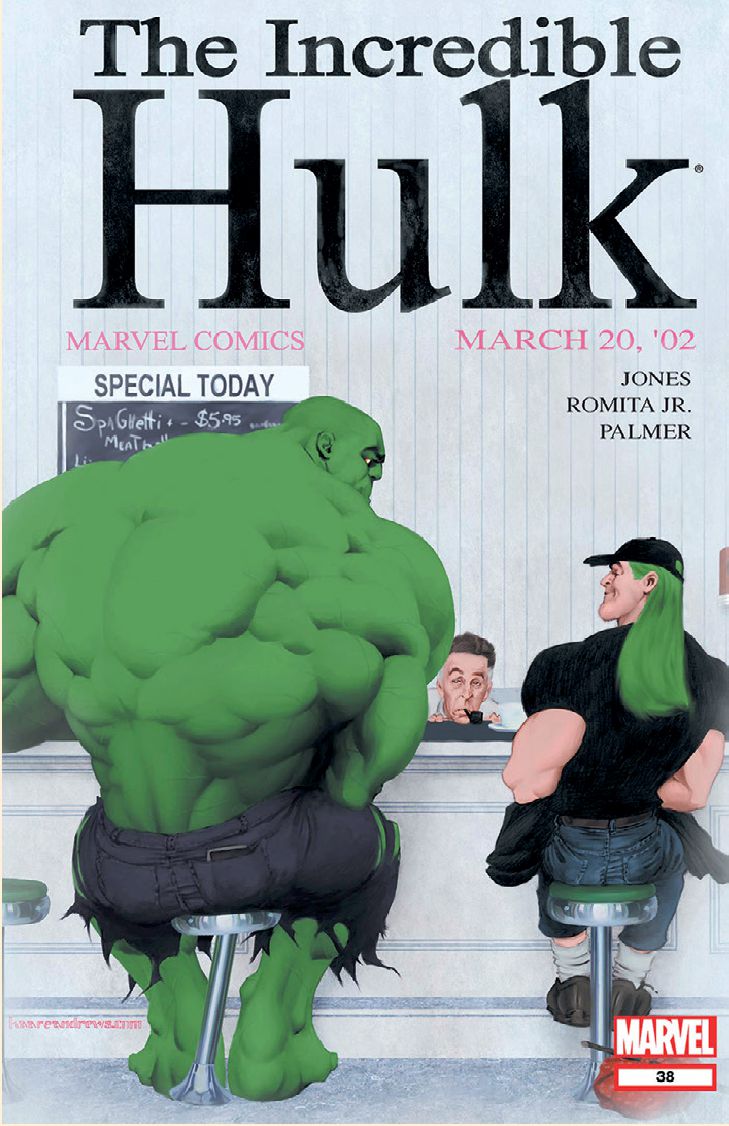
The Incredible Hulk cover by Jones, 2002

Jones, The Incredible Hulk (cover), 2002.

Compare the Artworks

Find similarities between The Runaway and the two imitations. Name at least two.
Trouve des points communs entre The Runaway et les deux imitations. Nomme-en au moins deux.
Find differences between the original and the imitations. Name at least two.
Trouve des différences entre l’original et les imitations. Nomme-en au moins deux.
Which imitation is your favourite? Why?
Quelle imitation préfères-tu ? Pourquoi ?

Speaking Task: The Story in the Painting

The task
Choose one of the three artworks. Imagine you are one of the characters and tell your story to the class.
Choisis une des trois œuvres. Imagine que tu es l’un des personnages et raconte ton histoire à la classe.
Look at your artwork and prepare a few notes, then speak — don’t just read.
Regarde ton œuvre et prépare quelques notes, puis parle — ne lis pas simplement.
about 2 minutes
Hints
Who are you? +
I'm the little boy. I'm the policeman. I'm Spider-Man.
Where are you? +
I'm in a diner. I'm sitting at the counter.
What are you doing? +
I'm talking to a policeman. I'm holding a red bundle.
How do you feel? +
I'm worried. I'm tired. I'm a bit scared.
Grille d'évaluation — présentation orale
Marking guide — oral presentation
… / 20
Content
The story is clear and imaginative.
… / 5Contenu
Language
BE + V-ing used to describe actions.
… / 5Langue
Fluency
Speaks with few hesitations, does not just read.
… / 5Aisance
Accuracy
Correct -ing forms and pronouns.
… / 5Correction
Choose one artwork
The Runaway The Runaway
Rockwell Spiderman Spider-Man
The Incredible Hulk The Hulk
My preparation notes

Crossword: Characters & Actions

Expression mystère :
→ Across
1.very happy
2.feeling anxious or troubled
3.moving fast on your legs
4.a person whose job is to keep order
5.finding something funny
6.having tears because you are sad
↓ Down
1.using your eyes to see
2.moving your body to music
3.resting on a chair or a stool
4.a child who leaves home
5.keeping something in your hands
6.showing you are happy with your mouth

Translation Task: Comparing Artworks

Build the sentence in English
Clique sur une flèche pour lancer la roulette.

Séance 3 : Words & Grammar: BE + V-ing (– / ?)

  • Objectif : Consolider le vocabulaire de l’art et des sentiments et employer le présent en BE + V-ing aux formes négative et interrogative.
  • Activités : jeu de tri (place dans le tableau), jeu des catégories de vocabulaire, commentaires du livre d’or, mots croisés du vocabulaire de l’art, kit de grammaire, écoute d’une devinette, exercices variés (formes négative et interrogative), tâche de traduction.
  • À retenir : Savoir poser une question (Is she running? What are you doing?), savoir répondre (Yes, she is / No, she isn’t) et savoir dire ce qui ne se passe pas (he isn’t playing).

Sort: Where in The Runaway?

Sort each element into its place in The Runaway: at the top, in the middle or at the bottom.
Classe chaque élément selon sa place dans le tableau The Runaway : en haut, au milieu ou en bas.
Top
Middle
Bottom

Speaking Game: Spin the Wheel

The task
In teams, spin the wheel. When you land on a category, say as many English words as you can from that category about the paintings — one after the other.
En équipes, faites tourner la roue. Quand vous tombez sur une catégorie, dites le plus de mots possible de cette catégorie sur les tableaux, l'un après l'autre.
Play in two teams: a word already said cannot be said again.
Jouez en deux équipes : un mot déjà dit ne peut pas être redit.
en équipes
Hints
Artwork +
a painting, a portrait, an artist, a photograph.
Composition +
in the middle, on the left, in the background, dark colours.
Emotions +
happy, sad, excited, worried, amused.
Opinions +
I like it, it's funny, it's great, I don't understand it.
Grille d'évaluation — présentation orale
Marking guide — oral presentation
… / 20
Content
Says several correct words in the right category.
… / 5Contenu
Language
Uses the art, composition, emotion and opinion vocabulary.
… / 5Langue
Fluency
Answers quickly and clearly.
… / 5Aisance
Accuracy
Says the words correctly.
… / 5Correction
Spin the wheel!
Artwork Composition Emotions Opinions

The Visitors' Book

Some people have left comments in the museum visitors' book. How do they feel about The Runaway?
Des visiteurs ont laissé des commentaires dans le livre d’or du musée. Que ressentent-ils pour The Runaway ?
a.
“Wow, it's fantastic! I love it.”
« Waouh, c’est fantastique ! J’adore ! »
b.
“I don't understand it. It's strange.”
« Je ne comprends pas. C’est étrange. »
c.
Now, write your own comment in the visitors' book about The Runaway.
Maintenant, écris ton propre commentaire dans le livre d’or sur The Runaway.

Crossword: Art Vocabulary

Expression mystère :
→ Across
1.a strong feeling
2.a picture made with paint
3.the way the elements are placed in a picture
4.full of energy and happiness
5.the part of a picture that is near, at the front
6.to say what something looks like
↓ Down
1.the look on someone's face
2.not funny; solemn
3.very excited and happy
4.the part of a picture that is far away, at the back
5.a person who makes art

Grammar Kit: Le présent en BE + V-ing (– / ?)

L’idée générale

On peut mettre le présent en BE + V-ing à la forme négative et à la forme interrogative.

  • Négative = pour dire ce qui ne se passe pas.
  • Interrogative = pour poser une question sur une action.
  • On garde toujours le verbe en -ing.
La forme
  • Négatif : sujet + BE + not + verbe-ing
  • he isn't playing · they aren't playing
  • Interrogatif : BE + sujet + verbe-ing ?

She isn't sleeping.

Elle ne dort pas.

Is he running?

Est-ce qu’il court ?

Les réponses courtes

Pour répondre à une question en BE + V-ing, on utilise des réponses courtes.

  • Yes, + sujet + BE. → Yes, she is.
  • No, + sujet + BE + n't. → No, she isn't.

Is she eating? — Yes, she is.

Est-ce qu’elle mange ? — Oui.

Astuce : les questions en Wh-
  • What / Where / Why + BE + sujet + verbe-ing ?
  • What are you doing? · Why is the boy running?

Audioguide: The Guessing Game

Two pupils play a guessing game: one asks yes/no questions to find a picture, the other answers.

Deux élèves jouent à un jeu de devinettes : l’un pose des questions par oui ou non pour trouver une image, l’autre répond.

Classroom audio — guessing game

Script
_____
Pupil 1
Is the girl playing?
_____
Pupil 2
No, she isn't.
_____
Pupil 1
Is she eating?
_____
Pupil 2
Yes, she is.
_____ _____
Pupil 1
Is she eating a sandwich?
_____
Pupil 2
No, she isn't.
_____ _____
Pupil 1
Is she eating a banana?
_____
Pupil 2
No, she isn't.
_____ _____ _____ _____
_____
Pupil 1
I know, it's Mary in Norman Rockwell's painting Day in the life of a girl.
It's picture 13!
_____
_____
Pupil 2
Yes, good job!
My turn!

Correct or incorrect?

Read these questions and sentences. Which ones use BE + V-ing correctly?
Lis ces questions et ces phrases. Lesquelles utilisent correctement BE + V-ing ?

    Choose: The Negative Form

    Choose the correct negative form (BE + not + V-ing).
    Choisis la bonne forme négative (BE + not + V-ing).
    • Look! The boy (aren't running/isn't running).
    • The girls (aren't playing/isn't playing).
    • I (aren't drawing/'m not drawing).

    Describe: The Runaway

    Look at The Runaway. Describe what the people are doing.
    Regarde The Runaway. Décris ce que font les personnages.
    a.
    What are the little boy and the policeman doing?
    Que font le petit garçon et le policier ?
    b.
    What is the bartender doing?
    Que fait le serveur ?
    c.
    What is the policeman doing?
    Que fait le policier ?

    Describe: Going and Coming

    In the back of the car, a girl has some chewing gum. What is she doing?
    À l’arrière de la voiture, une fille a du chewing-gum. Que fait-elle ?
    Going and Coming has two parts, one on top of the other. What happens at the top and at the bottom?
    Going and Coming a deux parties, l’une au-dessus de l’autre. Que se passe-t-il en haut et en bas ?
    How does Going and Coming make you feel? Give your opinion.
    Que ressens-tu devant Going and Coming ? Donne ton avis.

    Give a Reason: The Runaway

    Look at The Runaway. Give a reason for each sentence. Use “because” + BE + V-ing.
    Regarde The Runaway. Donne une raison pour chaque phrase. Utilise « because » + BE + V-ing.
    a.
    The bartender is smiling because…
    Le serveur sourit parce que…
    b.
    The policeman looks curious because…
    Le policier a l’air curieux parce que…
    c.
    The three people are talking because…
    Les trois personnages parlent parce que…

    True or False: Going and Coming

    Look at Going and Coming. The family drives to the lake (top) and comes home (bottom). True or false? Correct the false statements.
    Regarde Going and Coming. La famille va au lac (en haut) et rentre (en bas). Vrai ou faux ? Corrige les phrases fausses.
    a.
    “The father is sleeping.”
    « Le père dort. »
    b.
    “The children are sleeping.”
    « Les enfants dorment. »
    c.
    “At the bottom, they look happy and full of energy.”
    « En bas, ils ont l’air contents et pleins d’énergie. »

    Translation Task: Questions & Negatives

    Build the sentence in English
    Clique sur une flèche pour lancer la roulette.

    Évaluation : Grammaire

    • Type d'évaluation : QCM de grammaire (20 questions à choix unique)
    • Axe : Axe 5 — Arts et expression des sentiments
    • Compétences : A1 → A2 — Le présent en BE + V-ing (affirmatif, négatif, interrogatif) et le lexique de l’art
    • Coefficient : 1
    Nom, Prenom :
    Classe :
    Date :
    Note :
    Axe : Arts et expression des sentiments
    CECRL : A1 → A2
    Activité langagière : Grammaire + lexique
    Compétence : Le présent en BE + V-ing (affirmatif, négatif, interrogatif)
    ÉVALUATION — BE + V-ing Questions à choix unique
    1.
    The girl ___ smiling.
    2.
    The children ___ playing.
    3.
    What is the -ing form of the verb “run”?
    4.
    What is the -ing form of the verb “ride”?
    5.
    What is the -ing form of the verb “smile”?
    6.
    (Negative) He ___ sleeping.
    7.
    (Negative) They ___ eating.
    8.
    ___ she running?
    9.
    ___ they dancing?
    10.
    “Is the boy crying?” — “No, ___.”
    11.
    “Are you drawing?” — “Yes, ___.”
    12.
    ___ are you doing?
    13.
    ___ is the boy running? (you want a reason)
    14.
    A painting of a person is a ___.
    15.
    The part of a picture that is far away is the ___.
    16.
    He is not happy. He looks ___.
    17.
    I really like it! It’s ___.
    18.
    ___ the middle of the painting, there is a car.
    19.
    Rockwell’s work is a painting, ___ the modern one is a photograph.
    20.
    The father ___ driving the car.