Séance 1 : Step in on the Mat!

  • Objectif : Découvrir et comprendre un premier extrait de The Cat in the Hat grâce à la lecture accompagnée et animée.
  • Activités : Anticipation à partir d'une illustration, découverte de Dr. Seuss et de la stratégie « écrire en s'inspirant d'un modèle », lecture des extraits, repérage des personnages, des émotions et des objets, lecture à voix haute.
  • À retenir : Savoir comprendre un texte rimé et identifier les personnages, leurs émotions et les objets décrits.

Brainstorm: The Cat in the Hat

Say what you think happens in this Dr. Seuss story.
Dis ce qui se passe, à ton avis, dans cette histoire de Dr. Seuss.
Your words will appear here.

Document: The Cat in the Hat

The Cat in the Hat

— Part 1: A Cold, Wet Day —
_____ _____
_____ _____
_____ _____
_____
_____ _____
_____ _____ _____
_____ _____
_____ _____
_____ _____
_____ _____
_____ _____
_____ _____
_____ _____
_____ _____ _____
_____ _____ _____
_____ _____
_____ _____ _____
The Cat in the Hat book cover
The sun did not shine.
It was too wet to play.
So we sat in the house
all that cold, cold, wet day.


I sat there with Sally.
We sat there, we two.
And I said, “How I wish
we had something to do!”


Too wet to go out
and too cold to play ball.

So we sat in the house.
We did nothing at all.

So all we could do was to sit!

And we did not like it.
Not one little bit.
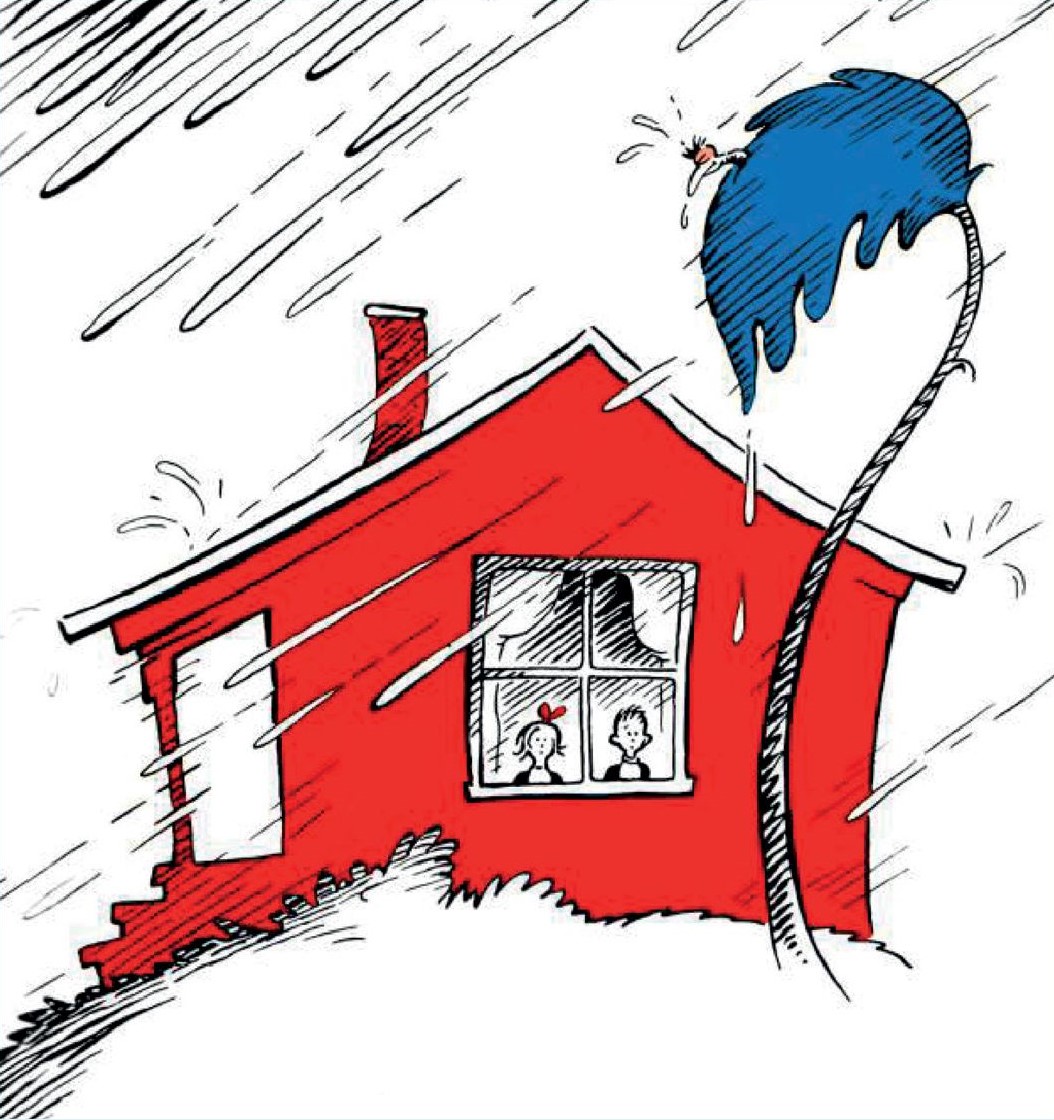

An illustration from The Cat in the Hat
And then
something went BUMP!

How that bump made us jump!
Then we saw him step in on the mat!
We looked!
And we saw him!
The Cat in the Hat!

And he said to us,
“Why do you sit there like that?


I know it is wet
and the sun is not sunny.

But we can have
lots of good fun that is funny!”

The Cat in the Hat — by Dr. Seuss (1957)

Comprehension: Step in on the Mat!

Read Extract 1 again. Look at the characters and their feelings.
Relis l’extrait 1. Observe les personnages et leurs émotions.
Who are the two children at home?
Qui sont les deux enfants à la maison ?
Why must they stay in the house?
Pourquoi doivent-ils rester à la maison ?
How do the children feel, and who suddenly steps in?
Comment se sentent les enfants, et qui entre soudain ?

Comprehension: Fun and Rhymes

Look at Extract 1 again. Think about the activities and the rhymes.
Regarde l’extrait 1. Pense aux activités et aux rimes.
What would the children like to do outside?
Qu’aimeraient faire les enfants dehors ?
What do the children do in the house instead?
Que font les enfants dans la maison à la place ?
Find two pairs of rhyming words in the extract.
Trouve deux paires de mots qui riment dans l’extrait.

Vocabulary Kit: Personality & Emotions

Personality & emotions
  • surprised = surpris(e)
  • puzzled = perplexe
  • anxious = anxieux, inquiet
  • worried = inquiet, préoccupé
  • friendly = amical, sympathique
  • playful = joueur, espiègle
  • entertaining = divertissant, amusant
  • joyful = joyeux
  • eccentric = excentrique
  • careful = prudent, soigneux
  • careless = négligent, étourdi (≠ careful)

Word Builder: -ful / -less

Build adjectives with -ful and -less

You can build an adjective by adding a suffix to a word.

  • -ful means "full of": care → careful, help → helpful, hope → hopeful, use → useful, joy → joyful, play → playful.
  • -less means "without": care → careless, hope → hopeless, use → useless.
  • So careful = qui fait attention, and careless = qui ne fait pas attention.
  • Try it: what do useless and hopeful mean?

Complete the text: How do they feel?

Complete the diary with the right words for the feelings.
Complète le journal intime avec les bons mots pour décrire les émotions.

Dear diary, today I forgot to do my homework! I was really anxious about it. But my teacher wasn’t mad! I was surprised. She was really nice about it. She is a very friendly teacher. But I must be more careful in the future!

Translation Task: A Rainy Day

Build the sentence in English
Clique sur une flèche pour lancer la roulette.

Séance 2 : Telling the Story in the Past

  • Objectif : Découvrir et employer le prétérit simple des verbes irréguliers.
  • Activités : Leçon de grammaire sur le prétérit irrégulier, association infinitif/prétérit, repérage et emploi du prétérit, traduction.
  • À retenir : Savoir conjuguer les principaux verbes irréguliers au prétérit (affirmatif et négatif).

Grammar Kit: Le prétérit — verbes irréguliers

Le prétérit simple

Le prétérit raconte des actions terminées dans le passé.

  • La forme est la même à toutes les personnes — sauf avec BE (was / were).
  • On l'accompagne souvent d'un marqueur de temps : yesterday, then, a long time ago.
La forme négative
  • did not (didn't) + base verbale (sans -ed, sans changement).

They did not like it.

Ils n'ont pas aimé ça.

The cat came in and held the cup.

Le chat est entré et a tenu la tasse.

Les irréguliers — par cœur
  • go → went · have → had · do → did · come → came · say → said · see → saw
  • sit → sat · fall → fell · hold → held · read → read · hear → heard · run → ran
  • get → got · give → gave · buy → bought · bring → brought · think → thought · find → found
  • be → was/were · eat → ate · feel → felt · break → broke · drive → drove · spend → spent · become → became

Grammar: Find the Past Verbs

Find the irregular past verbs in the extract from The Cat in the Hat: A Cold, Wet Day.
Trouve les verbes au prétérit irrégulier dans l'extrait de The Cat in the Hat : A Cold, Wet Day.
Find two past verbs and give the base form.
Trouve deux verbes au passé et donne la base verbale.
Find three more irregular past verbs in the story.
Trouve trois autres verbes irréguliers au passé.
How do you make these verbs negative in the past?
Comment mets-tu ces verbes à la forme négative au passé ?

Match: Infinitive and Past

Match each verb with its past simple form.
Associe chaque verbe à sa forme au prétérit.

    Speaking: Retell the Story

    Retell the beginning of the story using the past simple.
    Raconte le début de l’histoire en utilisant le prétérit.
    What was the weather like, and what did the children do?
    Quel temps faisait-il, et que faisaient les enfants ?
    How did they feel?
    Comment se sentaient-ils ?
    What happened next?
    Que s’est-il passé ensuite ?

    Choose the Correct Past Sentence

    Choose the correct past-tense sentences.
    Choisis les phrases correctes au passé.

      Translation Task: The Past Simple

      Build the sentence in English
      Clique sur une flèche pour lancer la roulette.

      Séance 3 : Mini Task: Create a Character

      • Objectif : Écrire en s’inspirant d’un modèle et jouer avec les rimes pour créer un personnage.
      • Activités : Stratégie « écrire en s’inspirant d’un modèle », jeu de rimes (personnages / objets), création et illustration d’un nouveau personnage, présentation à la classe.
      • À retenir : Savoir créer un personnage rimé sur le modèle « The ___ in the ___ » et le présenter.

      How to: Write Inspired by a Model

      Write inspired by a model

      You can write your own funny text by following a model — just like the Cat in the Hat!

      • Read the model carefully and find the pattern it repeats (for example: I can hold…).
      • Keep the same structure, but change the words: new objects, new actions.
      • Make your words rhyme and keep the rhythm — say them aloud.
      • The funnier and sillier, the better!

      Match: Rhyming Pairs

      Match each character with the object that rhymes with it.
      Associe chaque personnage à l’objet qui rime avec lui.

        Writing: Create Your Character

        The task
        Invent a new Dr. Seuss character, like the Cat in the Hat. Give it a rhyming name (The ___ in the ___), write two rhyming lines about it, and draw it.
        Invente un nouveau personnage à la manière de Dr. Seuss, comme le Cat in the Hat. Donne-lui un nom qui rime (The ___ in the ___), écris deux vers qui riment à son sujet, et dessine-le.
        20 – 30 mots
        Hints
        Rhyming names +
        The Goat in the Coat, The Fox in the Box, The Mouse in the House…
        Sentence model +
        Use: “Look! We saw him! The ___ in the ___!”
        Useful words +
        a hat, a coat, a box, a house, silly, funny, crazy…
        Draw it +
        Draw your character in a big picture and write its name under it.
        Grille d'évaluation — production écrite
        Marking guide — written task
        … / 20
        Content
        Invents a character with a rhyming name and two lines.
        … / 5Contenu
        Language
        Uses the model “The ___ in the ___” and rhyming words.
        … / 5Langue
        Fluency
        The two lines rhyme and are fun to say.
        … / 5Aisance
        Accuracy
        Simple sentences are correct; the name rhymes.
        … / 5Correction
        Your ideas

        Translation Task: Create a Character

        Build the sentence in English
        Clique sur une flèche pour lancer la roulette.

        Évaluation : Grammaire + Vocabulaire

        • Type d'évaluation : QCM
        • Axe : Axe 4 — Imaginaire, contes et légendes
        • Compétences : A1-A2 — Le prétérit simple et le lexique (personnalité, suffixes)
        • Coefficient : 1
        Nom, Prenom :
        Classe :
        Date :
        Note :
        Axe : Imaginaire, contes et légendes — Dr. Seuss
        CECRL : A1
        Activité langagière : Grammaire — le prétérit (irréguliers)
        Compétence : Le prétérit simple : verbes irréguliers
        EVALUATION — Le prétérit Questions à choix unique
        1.
        Last week, I ___ to Seuss Landing. (go)
        2.
        I ___ two days there. (spend)
        3.
        I ___ so much fun. (have)
        4.
        It ___ amazing! (be)
        5.
        The Cat ___ in on the mat. (come)
        6.
        He ___ something funny. (say)
        7.
        Did you see the Cat play? Yes, we ___.
        8.
        The children ___ in the house. (sit)
        9.
        The Cat ___ a big mess. (make)
        10.
        Choose the correct negative:
        Nom, Prenom :
        Classe :
        Date :
        Note :
        Axe : Imaginaire, contes et légendes — The Cat in the Hat
        CECRL : A1
        Activité langagière : Vocabulaire
        Compétence : Lexique : actions, personnalité, suffixes
        EVALUATION — Vocabulaire Questions à choix unique
        1.
        “tomber” in English is…
        2.
        “sauter” is…
        3.
        “tenir” is…
        4.
        “ramasser” is…
        5.
        “regarder” is…
        6.
        Someone who is fun and likes to play is…
        7.
        Someone strange and unusual is…
        8.
        Which suffix on “care” means the opposite (qui ne fait pas attention)?
        9.
        “help” + a suffix meaning “full of” gives…
        10.
        If you feel worried and nervous, you are…