What's in Your Brain?
Information
- Texte : « What's in your BRAIN? » — le cerveau de Greg
- Audio : Le cerveau de Greg
- Vidéo : Arayah & Tommy présentent leur cerveau
- Séance 1 : Tell Us More!
Séance 1 : Tell Us More!
- Objectif : Comprendre une description simple de goûts et d’intérêts, et apprendre à dire ce qu’il y a avec There is / There are.
- Activités : anticipation « What’s in your brain? », lecture du cerveau de Greg, compréhension de l’oral, vocabulaire des centres d’intérêt, des animaux et des goûts, et découverte de la structure There is / There are.
- À retenir : Savoir dire ce qu’il y a avec There is (singulier) et There are (pluriel), et savoir parler de ses centres d’intérêt, de ses animaux et de ses goûts.
What’s in your brain?
Document: What’s in your brain?
Greg shows you what’s inside his brain. Which words do you already know?
Greg te montre ce qu’il y a dans son cerveau. Quels mots connais-tu déjà ?
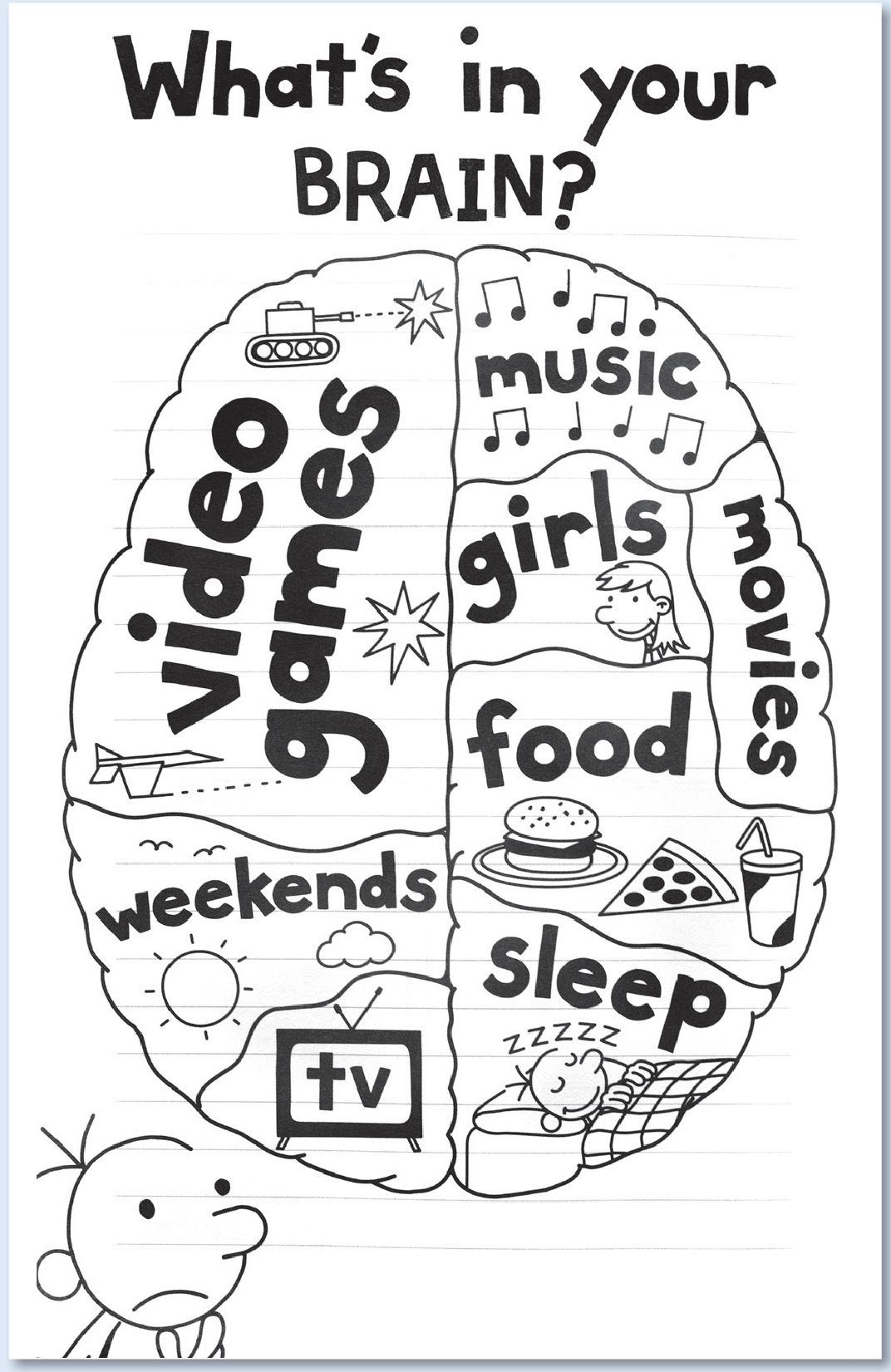
From the Wimpy Kid Do-It-Yourself Book, Jeff Kinney.
Document: In Greg’s brain
Listen to what’s inside Greg’s brain.
Écoute ce qu’il y a dans le cerveau de Greg.
From the Wimpy Kid Do-It-Yourself Book, Jeff Kinney. (0’36)
What’s in Greg’s brain?
Vocabulary Kit: What’s in your brain?
- a rabbit = un lapin
- a dog = un chien
- a cat = un chat
- a guinea pig = un cochon d’Inde
- a hamster = un hamster
- a fish = un poisson
- my favourite book = mon livre préféré
- I like video games = j’aime les jeux vidéo
- I love dancing = j’adore danser
- food = la nourriture
- cinema = le cinéma
- TV = la télé
- reading = la lecture
- sleep = le sommeil
- listening to music = écouter de la musique
- art = l’art
- school = l’école
- family = la famille
- seeing my friends = voir mes amis
- staying home = rester à la maison
- going out = sortir
- football = le football
- basketball = le basket
- dancing = la danse
- cycling = le vélo
- drawing = le dessin
- acting = le théâtre
Oral Translation: What’s in your brain?
Document: More brains!
Arayah and Tommy show you what’s inside their brains. Who are you more similar to?
Arayah et Tommy te montrent ce qu’il y a dans leur cerveau. À qui ressembles-tu le plus ?
Arayah and Tommy — video portrait. (0’55)
Grammar Kit: There is / There are
There is / There are se traduisent par « il y a ». On les utilise pour dire ce qu’il y a quelque part.
- There is + nom au singulier (a cat, music)
- There are + nom au pluriel (pets, movies)
- There’s = forme contractée de there is
There is a cat in my brain.
Il y a un chat dans mon cerveau.
There are movies too.
Il y a aussi des films.
On décrit ce qu’il y a dans un lieu ou dans le cerveau de quelqu’un.
- In Greg’s brain, there is music.
- In my brain, there are video games.
- BE s’accorde avec le premier nom qui suit.
- À l’oral, on entend souvent there’s.
There is or There are?
- a. In my brain, there is/there are a cat.
- b. In Greg’s brain, there is/there are video games.
- c. In my brain, there is/there are music.
- d. In Arayah’s brain, there is/there are pets.
- e. In Tommy’s brain, there is/there are movies.
- f. In my brain, there is/there are a hamster.
Grammar Kit: Le déterminant zéro ∅
En anglais, on n’utilise aucun article (∅) devant certains noms, au sens général.
- Devant un nom indénombrable : there is ∅ food
- Devant un nom pluriel général : there are ∅ movies
In my brain there is ∅ food.
Dans mon cerveau, il y a de la nourriture.
In my brain there are ∅ movies.
Dans mon cerveau, il y a des films.
- Pas de a / an ni de the quand on parle en général.
- On garde a / an pour un objet précis au singulier (a cat).
- Le français met « du, de la, des » là où l’anglais ne met rien (∅).
The zero determiner (∅)
- a. In my brain, there is ∅/the food.
- b. In my brain, there are ∅/the movies.
- c. There is ∅/a music.
- d. There are ∅/the video games.
- e. I have a/∅ dog.
- f. There is a/∅ hamster in my brain.
Complete with is or are
Rhythm & Sounds: Le schwa /ə/
Dans tout mot de deux syllabes ou plus, une seule syllabe est accentuée.
- Les autres syllabes sont réduites : on les entend moins.
- Leur voyelle devient souvent le son /ə/ (le schwa).
cinema → CIN-e-ma
chicken → CHIC-ken
hamster → HAM-ster
- Repère d’abord la syllabe forte, puis réduis les autres.
- Ne prononce pas chaque syllabe avec la même force qu’en français.
Écoute et entoure la syllabe accentuée : cinema, chicken, hamster.
The schwa /ə/
- a. cinema: CIN/E/MA
- b. chicken: CHIC/KEN
- c. hamster: HAM/STER
- d. family: FAM/I/LY
- e. rabbit: RAB/BIT
- f. computer: COM/PU/TER
Pronunciation: the schwa /ə/
Document: My brain (to complete)
Here is an empty brain, just like Greg’s. What is inside YOUR brain?
Voici un cerveau vide, comme celui de Greg. Qu’y a-t-il dans TON cerveau ?
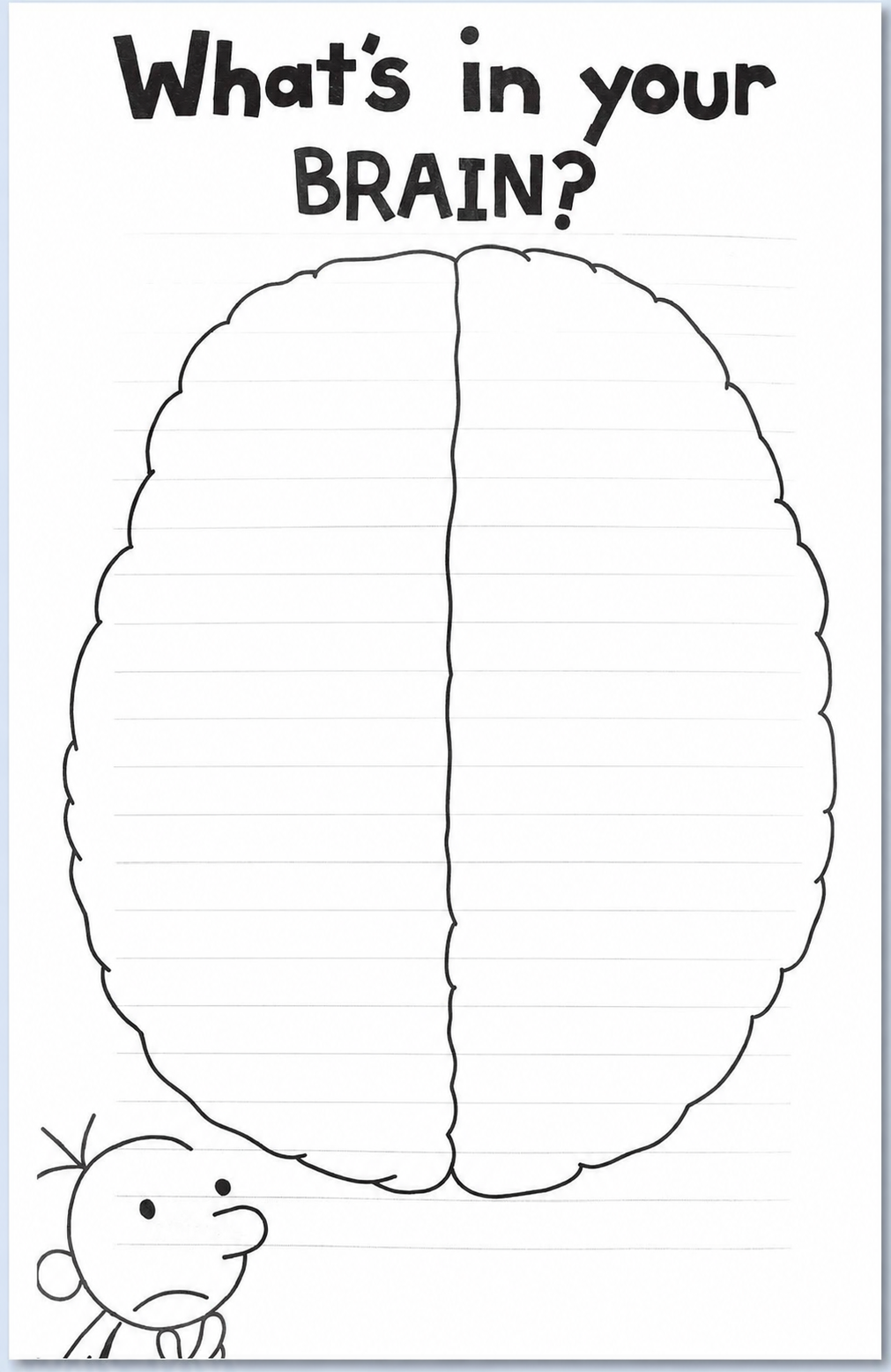
Adapted from the Wimpy Kid Do-It-Yourself Book, Jeff Kinney.
Mini Task: What’s in YOUR brain?
Sort by category
Find the intruder
- a. pizza/football/soda/burger
- b. cat/rabbit/school/guinea pig
- c. movies/cinema/TV/video games
- d. pets/badminton/dancing/volleyball
- e. juice/soda/judo/water
- f. rabbit/school/hamster/fish
- g. burger/drawing/acting/dancing
- h. football/tennis/cinema/basketball