Séance 1 : A Country in Words

  • Objectif : Rebrasser tout le lexique du pays — les gens, la faune, les paysages, le voyage — et décrire un paysage à l'oral comme à l'écrit.
  • Activités : Lexique du voyage, de l'orientation et des impressions ; mots et définitions à associer ; anagrammes ; les sept animaux du chapitre ; récit de Marta à compléter ; dialogue entre Annie et Marta ; ce que j'aimerais voir et mes impressions ; anagrammes de géographie ; description d'un paysage à écouter et à dessiner ; photo de la chute d'eau ; carte postale ; gravure d'un campement d'hiver ; description avec un intrus ; atelier de traduction ; morpion.
  • À retenir : Savoir nommer les animaux, les paysages et les institutions du Canada, savoir dire qu'un lieu est proche ou difficile d'accès, savoir décrire ce qu'il y a sur une image.

Vocabulary Kit: Travelling and Finding Your Way

Near or far
  • close by ≠ far away = tout près ≠ loin
  • difficult to get to ≠ easy to get to = difficile d'accès ≠ facile d'accès
  • up in the north of Canada = tout au nord du Canada
  • up north = dans le Nord
Getting around
  • to drive somewhere = aller quelque part en voiture
  • to travel by (plane, car…) = voyager en (avion, voiture…)
  • to get somewhere easily = se rendre facilement quelque part
Describing a scene
  • a camp = un campement
  • a lodge = une hutte, un abri
  • a sled = un traîneau
  • snowshoes = des raquettes
  • a rocky hill = une colline rocheuse
  • a pedestrian bridge = une passerelle
Your impressions
  • I'm impressed = je suis impressionné(e)
  • It's amazing / It's awesome = c'est extraordinaire / c'est génial
  • It makes me think of… = cela me fait penser à…
  • It makes me feel… = cela me donne l'impression d'être…

Match: Words and Their Meanings

Match each definition or clue with the right word or expression. Careful: one clue has three possible answers!
Relie chaque définition ou indice au bon mot ou à la bonne expression. Attention : un des indices a trois réponses possibles !

    Anagram: Politics and Society

    Put the letters back in the right order to find the word.
    Remets les lettres dans l'ordre pour retrouver le mot.

    Match: Name the Animals

    Say the name of each animal, then match it to its picture.
    Dis le nom de chaque animal, puis associe-le à sa photo.

    Complete the text: Marta’s Canada

    Complete Marta’s text with the words in the bank.
    Complète le texte de Marta avec les mots de la banque.Word bank: origins – heritage – official languages – French-speaking – diverse – descent – English-speaking

    Canada is a really diverse society. I was born in Canada but I am of Polish descent. Most of the people in my class have different origins as well. They are proud to be Canadian but also identify with their family’s heritage. We are at a bilingual school. It is both French-speaking and English-speaking. Those are our official languages.

    Complete the Conversation: Annie Visits Marta

    Complete the conversation between Annie and Marta with the words in the bank.
    Complète la conversation entre Annie et Marta avec les mots de la banque.Word bank: difficult to get to – great – capital – national park – prime minister – up in the north – moose – far away – awesome – polar bears – south – government – border
    • Annie: I can’t wait to come to Canada! Am I going to see lots of moose and polar bears?
    • Marta: Haha maybe, but Canada is more than animals and snow! Most Canadians I know have never even seen those animals. You definitely won’t see a polar bear because they live up in the north. It’s really far away and difficult to get to. Most Canadians live in the south close to the American border. We can go to a national park close by though!
    • Annie: That will be great. I would really like to see the Canadian lakes and woods. And I must say I’d also like to catch a glimpse of your prime minister!
    • Marta: I can’t promise you will see him but we can go to the capital, Ottawa, and see the government buildings.
    • Annie: Cool! And I’d really like to eat Canadian food as well.
    • Marta: Ok, I know what you must try: poutine! It’s fries, cheese and gravy and it’s awesome!

    Your Turn: What Would You Like to See in Canada?

    Make a list of what you would like to see and visit in Canada.
    Fais une liste de ce que tu aimerais voir et visiter au Canada.
    Give your impressions in each situation.
    Donne tes impressions dans chaque situation.
    Tu es dans une grande ville du Canada et ça te rappelle un endroit que tu as déjà visité.
    Tu visites un lac tellement énorme que tu te sens minuscule !
    Tu manges de la poutine et c'est incroyable !

    Anagram: Geography & Describing an Image

    Put the letters back in the right order to find the word.
    Remets les lettres dans l'ordre pour retrouver le mot.

    Document: Listen and Draw

    Someone describes a landscape they are looking at, piece by piece.

    Quelqu’un décrit, morceau par morceau, un paysage qu’il a sous les yeux.

    Script
    _____ _____ _____
    _____ _____ _____
    _____ _____ _____ _____ _____ _____ _____
    _____ _____ _____ _____ _____
    _____ _____ _____ _____
    _____ _____ _____
    _____ _____ _____ _____ _____ _____ _____
    _____ _____ _____ _____
    _____ _____ _____
    _____ _____ _____
    _____ _____ _____ _____ _____
    _____ _____ _____ _____ _____ _____ _____ _____
    This is a picture of a beautiful waterfall.
    It's a large waterfall of white water
    and there is also a smaller waterfall running down the rock on the left side.
    On the right and left of the photo you have a rocky hill
    and on the top you have some woods.
    It seems like Autumn up north
    because some of the trees are dark orange and yellow and red.
    Above the waterfall there is a walking bridge,
    a pedestrian bridge with lots of people.
    It could be part of a national park.
    The water at the base of the falls is dark blue
    with a group of white birds on the left side and a wooden structure on the right.

    Writing Task: Draw What You Hear

    NOM, Prénom :
    Classe :
    Date :
    Note :
    The task
    1. Listen to the description again and draw the landscape in the frame on your sheet.
    2. Then write three sentences under your drawing, saying what there is in it.
    3. Compare with your classmates: whose drawing is the most accurate?
    1. Réécoute la description et dessine le paysage dans le cadre de ta fiche.
    2. Écris ensuite trois phrases sous ton dessin pour dire ce qu’il y a dessus.
    3. Compare avec tes camarades : quel dessin est le plus fidèle ?
    Hints
    Les chutes d’eau +
    Combien de chutes d’eau ? Où est la plus petite ?
    Les côtés et le haut +
    Que voit-on à droite, à gauche, et en haut de la photo ?
    La saison +
    Quelle saison ? À quoi le sait-on ?
    Au-dessus et à la base +
    Qu’y a-t-il au-dessus de la chute ? Et à la base ?
    Example: · Exemple : +
    There is a large waterfall in the middle of my drawing and a smaller one on the left. There are woods at the top and a rocky hill on each side. Above the waterfall there is a bridge with people on it.
    Grille d'évaluation — production écrite
    Marking guide — written task
    … / 5
    Content
    Le dessin comporte au moins cinq éléments de la description.
    … / 3Contenu
    Language
    Les trois phrases emploient there is / there are correctement.
    … / 2Langue
    Your drawing and your three sentences

    Document: The Waterfall

    The waterfall described in the recording, photographed from the water.

    La chute d'eau décrite dans l'enregistrement, photographiée depuis l'eau.
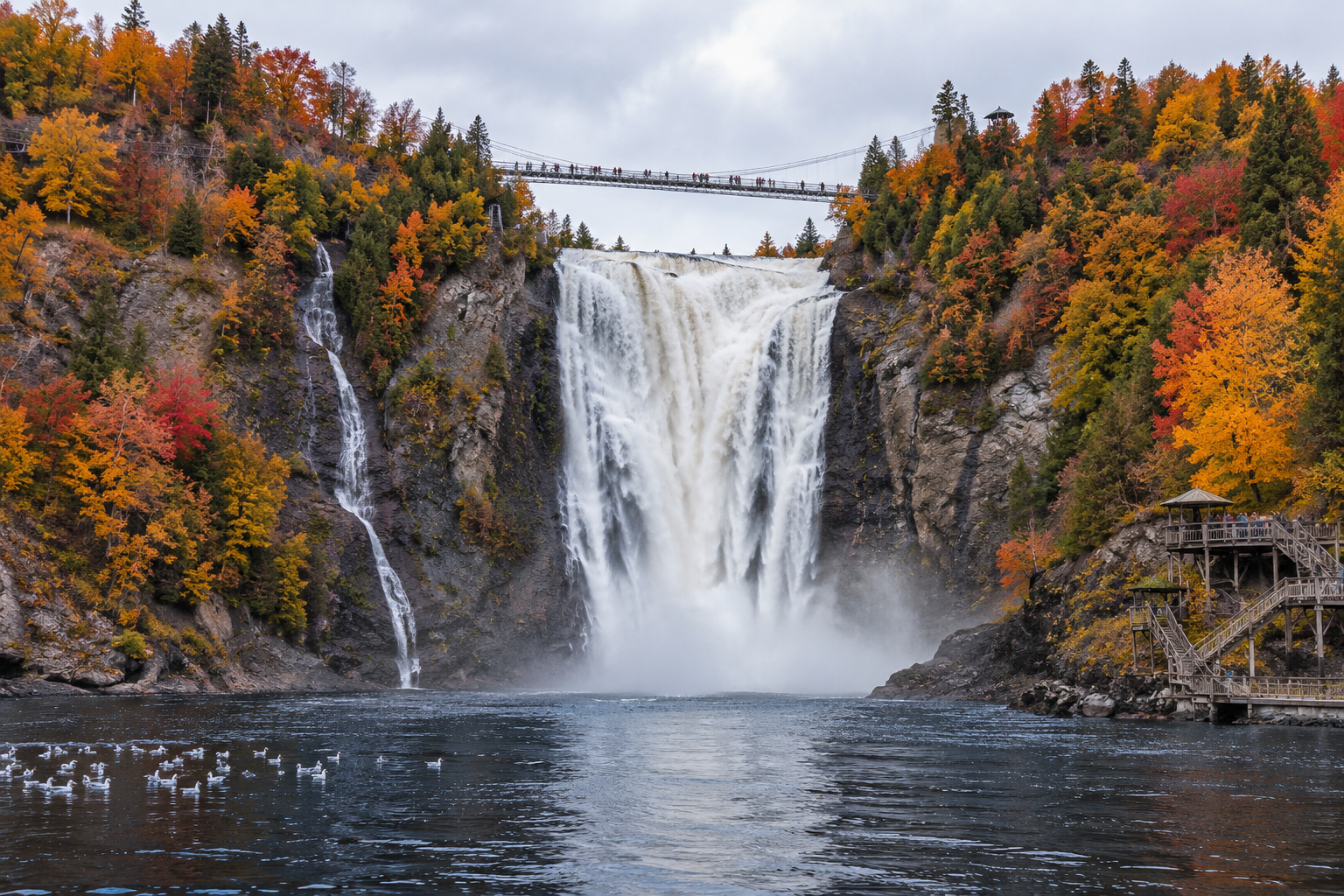
    A large waterfall between two rocky hills covered in trees, with a suspension bridge above it and birds on the water below.

    Montmorency Falls, Quebec

    Writing Task: A Postcard from Canada

    NOM, Prénom :
    Classe :
    Date :
    Note :
    The task
    1. You are visiting the place in the photograph above.
    2. Write a postcard to an English-speaking friend: describe the place and give your impressions.
    3. Use some of these words: national park – difficult to get to – travel by car – woods – waterfall – rocky hill.
    1. Tu visites l'endroit de la photo ci-dessus.
    2. Écris une carte postale à un(e) ami(e) anglophone : décris l'endroit et donne tes impressions.
    3. Emploie quelques-uns de ces mots : national park – difficult to get to – travel by car – woods – waterfall – rocky hill.
    40 – 60 mots
    Hints
    La forme d'une carte postale +
    Dear…, au début ; See you soon! et ton prénom à la fin.
    Où tu es, comment tu es venu(e) +
    le lieu, le moyen de transport, si c'était facile ou difficile d'accès.
    Ce que tu vois +
    reprends les mots de ta description de la chute d'eau : there is / there are.
    Tes impressions +
    It's amazing · It makes me feel… · It reminds me of…
    Example: · Exemple : +
    Dear Tom, Hello from Canada! I am having a brilliant time. We are staying in a national park. We travelled by car but it was quite difficult to get to. The scenery here is breathtaking. There is a huge waterfall between two rocky hills and the woods are amazing! I love it! See you soon! Jake
    Grille d'évaluation — production écrite
    Marking guide — written task
    … / 10
    Content
    Le lieu décrit, et au moins deux impressions.
    … / 4Contenu
    Format
    Une carte postale : formule d'appel, formule de fin, prénom.
    … / 2Forme
    Vocabulary
    Au moins trois mots de la liste.
    … / 2Lexique
    Language
    Correction de la langue, there is / there are.
    … / 2Langue
    Your postcard

    Document: A Winter Camp

    An old coloured engraving of a winter camp in the Canadian woods.

    Une ancienne gravure en couleurs : un campement d’hiver dans les bois canadiens.
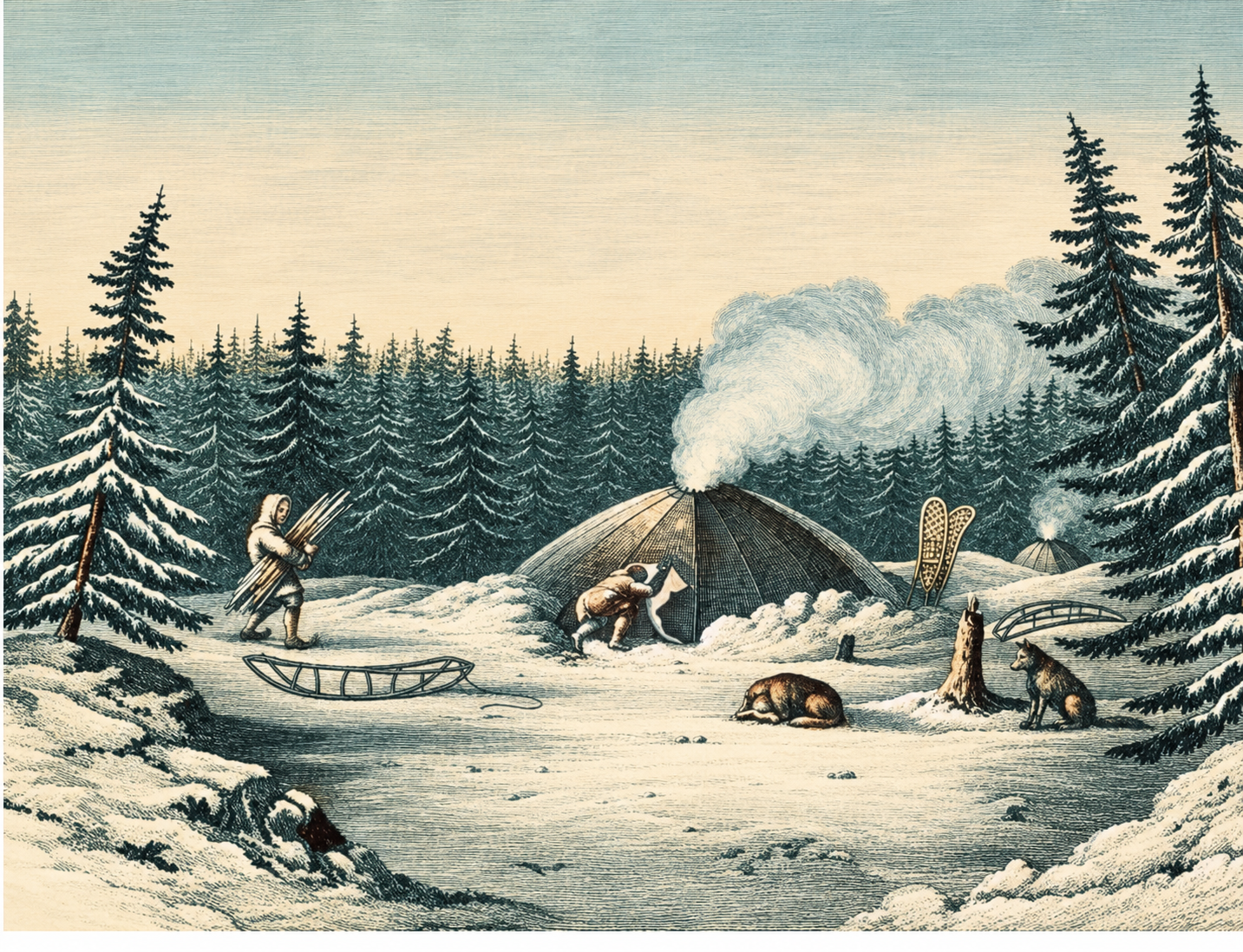
    An old coloured engraving of a winter camp in the Canadian woods.

    Speaking Task: Describe It — with One Intruder

    NOM, Prénom :
    Classe :
    Date :
    Note :
    The task
    Describe the picture above to a partner — but slip in one detail that is not there. Can they find the intruder?
    Décris l’image ci-dessus à ton camarade — mais glisse-y un détail qui n’y est pas. Saura-t-il trouver l’intrus ?
    environ 2 minutes
    Hints
    Le plan général +
    Commence par le plan général : quel type de paysage, quelle saison.
    Les trois plans +
    Puis l’arrière-plan, le milieu, le premier plan.
    L’intrus +
    Ton intrus doit être plausible : un animal, un objet, une couleur.
    Ton impression +
    Termine par ton impression sur l’image.
    Example: · Exemple : +
    This is a picture of a Canadian landscape. In the background there are lots of trees because the scene takes place in the woods. There is snow on the trees and on the ground. In the middle we can see some Aboriginal people who may be Inuits. There are also some animals in the picture.
    Mes notes de préparation

    Translation Task: A Country in Words

    Build the sentence in English
    Construis la phrase en anglais.

    Noughts and Crosses: Chapter Words

    Take turns. Choose a square and make a correct sentence with the word in it. If the sentence is right, the square is yours. Three in a row wins.
    Jouez chacun votre tour. Choisissez une case et faites une phrase correcte avec le mot qu’elle contient. Si la phrase est juste, la case est à vous. Trois cases alignées font gagner.
    A sentence needs a verb — “There is…” and “It is…” both work.
    Si tu bloques, commence par There is… ou It is a place where…
    Teams — games won

    Séance 2 : Grammar & Sounds

    • Objectif : Consolider there is / there are, les pronoms relatifs et les déterminants, et travailler les syllabes accentuées, le schwa et les sons /ð/ et /θ/.
    • Activités : Kit de grammaire there is / there are ; photo de la colline du Parlement ; atelier d'écriture ; remplacer that par who ou which ; relatifs dans le texte de Grace ; phrases à relier ; tri noms propres / noms communs ; enregistrement sur le patin à glace ; restitution orale ; enregistrement sur le Premier ministre ; nuage de mots ; trois enregistrements de prononciation ; syllabe accentuée des noms propres ; générateur de phrases ; tri /ð/ ou /θ/ ; atelier de traduction ; jeu de définitions.
    • À retenir : Savoir accorder BE avec le premier nom qui suit there, savoir choisir who, which ou where selon l'antécédent, savoir réduire les syllabes inaccentuées et distinguer /ð/ de /θ/.

    Grammar Kit: Révision — there is / there are

    1. There is + singulier, there are + pluriel

    Les deux se traduisent par « il y a » : c'est l'anglais qui distingue le singulier du pluriel, pas le français.

    There are many symbols in this photo that truly represent Canada.

    Il y a beaucoup de symboles sur cette photo qui représentent vraiment le Canada.

    There is never just one red chair.

    Il n'y a jamais qu'une seule chaise rouge.

    2. BE s'accorde avec le premier nom qui le suit

    Snow est singulier et arrive en premier : c'est lui qui commande l'accord, même si la phrase continue avec des pluriels.

    In this photo there is snow and ice surrounding the flag and red chairs.

    Sur cette photo, il y a de la neige et de la glace autour du drapeau et des chaises rouges.

    3. À la question et à la négation, there reste devant

    L'ordre des mots change autour de there, mais there ne disparaît jamais.

    How many official languages are there in Canada?

    Combien de langues officielles y a-t-il au Canada ?

    Is there a national holiday in Canada?

    Y a-t-il une fête nationale au Canada ?

    There isn't a bridge here. · There aren't any polar bears in Quebec.

    Il n'y a pas de pont ici. · Il n'y a pas d'ours polaires au Québec.

    Document: Parliament Hill, Ottawa

    A big stone building with a clock tower, under a blue sky with white clouds. In front of it, a marching band in red uniforms and tall black hats is playing, and a crowd is watching from behind the flowerbeds.

    Un grand bâtiment de pierre surmonté d'une tour-horloge, sous un ciel bleu parsemé de nuages blancs. Devant lui, une fanfare en uniforme rouge et grand bonnet noir joue, et la foule regarde depuis les massifs de fleurs.
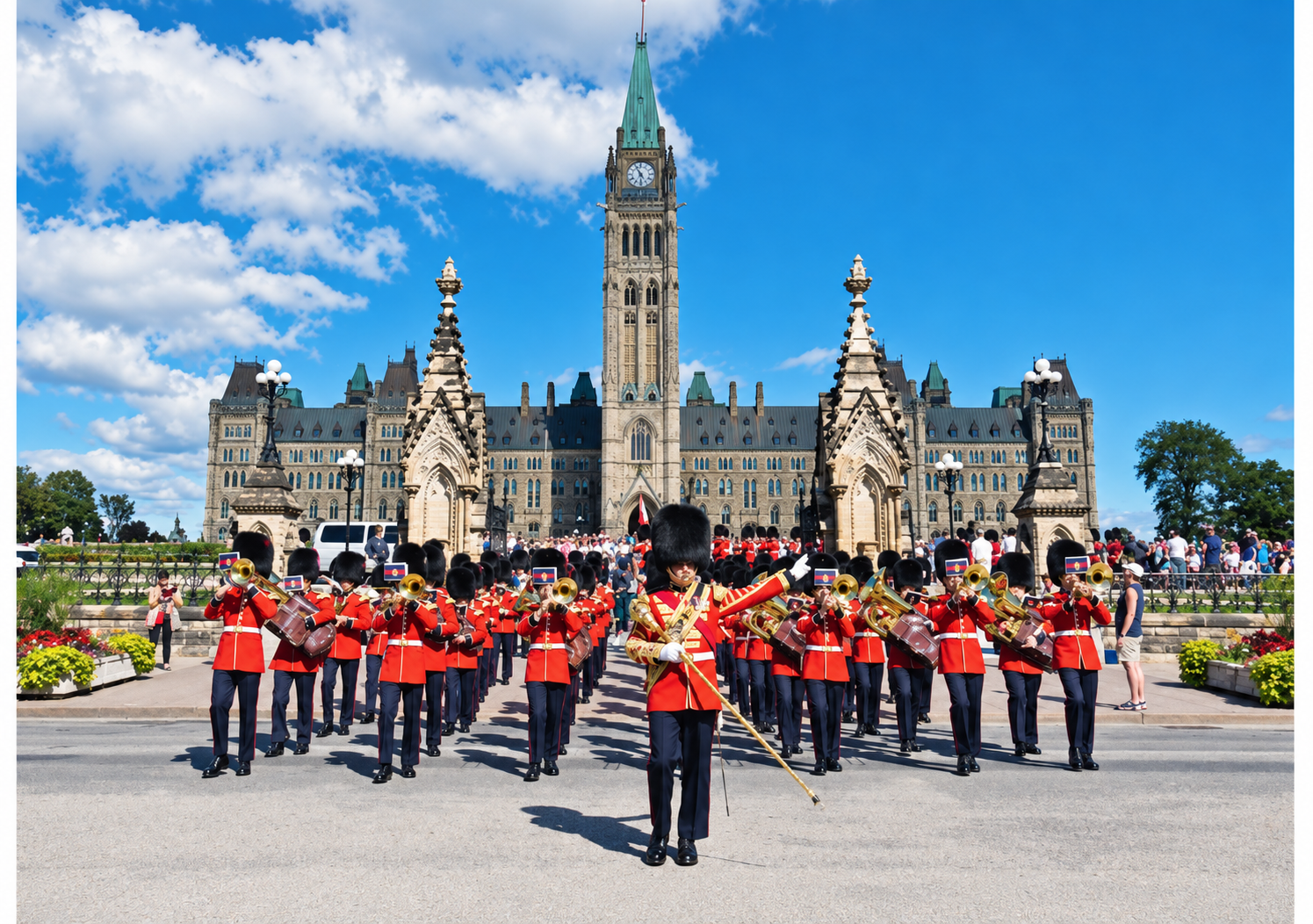
    A big stone building with a clock tower, under a blue sky with white clouds. In front of it, a marching band in red uniforms and tall black hats is playing, and a crowd is watching from behind the flowerbeds.

    Parliament Hill, Ottawa

    Writing Task: What Is There in This Photo?

    NOM, Prénom :
    Classe :
    Date :
    Note :
    The task
    Write six sentences saying what there is in the photo above. Use There is and There are.
    Écris six phrases pour dire ce qu'il y a sur la photo ci-dessus. Emploie There is et There are.
    6 phrases
    Hints
    Un seul ou plusieurs ? +
    C'est ce qui décide entre is et are.
    Balaie la photo +
    le bâtiment, la tour, la fanfare, la foule, le ciel.
    N'oublie pas l'article +
    a big building, lots of people.
    Example: · Exemple : +
    There is a marching band. There are lots of musicians. There are lots of people. There is a big building. There is a clock tower. There are clouds in the sky.
    Grille d'évaluation — production écrite
    Marking guide — written task
    … / 10
    Language
    Six phrases : un point par phrase — is ou are juste et le groupe nominal complet.
    … / 10Langue
    Your sentences

    Choose the right option: Replace that

    Replace that with who or which.
    Remplace that par who ou which.
    • It’s an old story (who/which) takes place in the north of Canada.
    • Do you know Ryan Gosling, the Canadian actor (who/which) is in La La Land?
    • Ice-hockey is a team sport (who/which) is played on ice, usually in a rink.
    • Justin Trudeau, the former Prime Minister of Canada (who/which) was elected in 2015, worked as a French teacher in Vancouver.

    Comprehension: Relatives in Grace’s Text

    Find the relative pronoun, say what it stands for, and rewrite the sentence with who or which.
    Trouve le pronom relatif, dis à quoi il renvoie et réécris la phrase avec who ou which.
    Three words that perfectly describe Canada, my inspiration for this piece.
    Canada is a country that shares beauty and happiness with everyone.
    In this country there are so many people that are making a difference not only here, but everywhere in the world.

    Practice: Join the Sentences

    Join each pair into one sentence, using a relative pronoun.
    Relie chaque paire en une seule phrase, à l'aide d'un pronom relatif.
    The Inuit usually live in Nunavut. It is in the north of Canada.
    There are many people in my family. They are spread throughout the country.
    There is a ferry. It goes along the bottom of the waterfall.
    Quebec city is a Canadian city. You can meet a lot of friendly people there.

    Sort: Proper Nouns and Common Nouns

    These noun phrases all come from Daniel’s statement. Sort them: does the phrase contain a proper noun or a common noun?
    Ces groupes nominaux viennent tous du texte de Daniel. Trie-les : le groupe contient-il un nom propre ou un nom commun ?
    A proper noun
    A common noun

    Document: Skating in Canada

    A class in Toronto talks about skating: where people skate, and the rinks they build at home.

    Une classe de Toronto parle du patin à glace : où l'on patine, et les patinoires que l'on construit chez soi.

    Script
    _____ _____ _____ _____
    Miss Lesinski:
    Ok, people, tell me about ice skating in Canada.
    _____ _____ _____ _____ _____ _____
    _____ _____ _____
    Emma:
    Many people in Canada do sports on ice such as hockey, figure skating
    and some just go skating for fun.
    _____ _____ _____ _____ _____
    _____ _____ _____ _____ _____
    _____ _____ _____ _____ _____ _____
    _____ _____
    Natalie:
    A famous place to go skating is the Rideau Canal in Ottawa
    and it’s a canal that in the winter freezes over
    and a lot of people from the community come and skate there.
    It’s really fun.
    _____ _____ _____ _____ _____
    _____ _____ _____ _____ _____
    _____ _____ _____ _____
    _____ _____ _____ _____
    _____ _____ _____ _____
    Iyonna:
    People do create rinks in their back yard.
    If you have like a pool or like a pond or something…
    or even you can just create it there and then.
    You can add the water and it will freeze over
    and you can, like, play hockey in your backyard.
    _____ _____ _____
    Miss Lesinski:
    Who likes skating here?
    _____
    _____
    _____
    _____
    Students:
    Me!
    I do!
    I love it.
    It’s awesome.

    Speaking Task: Tell a Partner What You Heard

    NOM, Prénom :
    Classe :
    Date :
    Note :
    The task
    Listen again and take notes. Then tell your partner three things you learnt about skating in Canada.
    Réécoute et prends des notes. Puis raconte à ton camarade trois choses que tu as apprises sur le patin à glace au Canada.
    3 choses
    Hints
    Note des mots, pas des phrases +
    les sports, le lieu, ce que l'on fait chez soi.
    Où patine-t-on ? +
    Qu'arrive-t-il à ce canal en hiver ?
    Que construisent certains dans leur jardin, et comment ? +
    Réécoute le dernier passage : la piscine, la mare, l'eau, le gel.
    Example: · Exemple : +
    Many Canadians do sports on ice, like hockey and figure skating. A famous place to skate is a canal in Ottawa, which freezes over in the winter. Some people make their own rink in their back yard.
    Grille d'évaluation — présentation orale
    Marking guide — oral presentation
    … / 5
    Content
    Trois informations correctes tirées de l’enregistrement.
    … / 3Contenu
    Fluency
    Phrases complètes, audibles, sans lecture de notes mot à mot.
    … / 2Aisance
    My notes

    Document: Young Canadians on Their Prime Minister

    The same class in Toronto, a few months after Justin Trudeau became Prime Minister in 2015, says what it thinks of him.

    La même classe de Toronto, quelques mois après l'arrivée de Justin Trudeau au poste de Premier ministre en 2015, dit ce qu'elle pense de lui.

    Script
    _____ _____ _____ _____ _____
    Miss Lesinski:
    Can you guys tell me what you think of our new Prime Minister?
    _____ _____ _____ _____ _____
    _____ _____ _____ _____ _____ _____
    _____ _____ _____ _____ _____
    Natalie:
    So our new Prime Minister is Justin Trudeau.
    He’s one of the youngest Prime Ministers we’ve ever had from the past Prime Ministers
    and in Canada we call them “Prime Ministers” and not a “president”.
    _____ _____ _____ _____ _____ _____ _____
    Gabrielle:
    I like how he’s very accepting of different cultures and races and he doesn’t allow discrimination.
    _____ _____ _____ _____ _____ _____
    _____ _____ _____
    Audrey:
    I also personally like him because he accepts different cultures and traditions and everything.
    And also because he speaks French.
    _____ _____ _____ _____
    Miss Lesinski:
    And what was his job before he became Prime Minister?
    _____ _____ _____
    Julianna:
    Justin Trudeau was a French teacher.
    _____ _____ _____
    Miss Lesinski:
    And anybody know anything about his dad?
    _____ _____ _____ _____ _____ _____ _____ _____
    Gabrielle:
    His dad was once the Prime Minister of Canada so he learned most of his skills from him.

    Word Cloud: What They Say about Their Prime Minister

    What did you understand? Say the words and phrases you caught about him.
    Qu'as-tu compris ? Dis les mots et les expressions que tu as repérés sur lui.
    Your words will appear here.

    Document: Say It Like a Canadian

    Three short recordings of Canadian English: A — place names, B — words with a weak syllable, C — words with th.

    Trois courts enregistrements en anglais canadien : A — des noms de lieux, B — des mots avec une syllabe faible, C — des mots avec th.

    A
    B
    C

    Pronunciation: Stressed Syllables in Canadian Names

    Listen to recording A. Copy each name and underline the stressed syllable. Then say it.
    Écoute l'enregistrement A. Recopie chaque nom et souligne la syllabe accentuée. Puis prononce-le.
    Canada
    Canadian
    Inuit
    Calgary
    Niagara Falls
    Ontario
    Quebec
    Toronto
    Vancouver

    Sentence Generator: Stressed Syllables & the Schwa

    Read the sentence aloud. Find the stressed syllable in the place name, and say the underlined syllables as /ə/.
    Lis la phrase à voix haute. Trouve la syllabe accentuée dans le nom propre, et prononce les syllabes soulignées /ə/.
    1 ...
    2 ...
    3 ...
    4 ...

    Sort: /ð/ or /θ/?

    Say each word aloud. Does the underlined letter sound /ð/ or /θ/?
    Dis chaque mot à voix haute. Les lettres soulignées se prononcent-elles /ð/ ou /θ/ ?
    /ð/
    /θ/

    Sentence Generator: Saying /ð/ and /θ/

    Read the sentence aloud. Watch the two th sounds.
    Lis la phrase à voix haute. Attention aux deux sons th.
    1 ...
    2 ...
    3 ...
    4 ...

    Translation Task: Grammar & Sounds

    Build the sentence in English
    Construis la phrase en anglais.

    Taboo: Define It Without Naming It

    Define the word on the card without ever saying it — and without using the forbidden words. Start with “It is a place where…”, “It is a lake which…”, “It is someone who…”.
    Définis le mot de la carte sans jamais le dire — et sans employer les mots interdits. Commence par « It is a place where… », « It is a lake which… », « It is someone who… ».
    Say it like this
    • It is a place where…
    • C’est un endroit où…
    • It is a person who…
    • C’est une personne qui…
    • It is a thing which…
    • C’est une chose qui…
    • It is the animal that…
    • C’est l’animal qui…
    Card 0 / 0 All the cards are done!
    ?
    Do not say

    Séance 3 : Canada Day Challenge!

    • Objectif : Choisir une image du Canada et rédiger sa propre note d'intention pour le concours, puis la présenter à la classe.
    • Activités : Lexique visuel pour parler d'une photo ; les quatre photos du concours ; préparation de la tâche finale en étapes ; rédaction de la note d'intention ; chanson Across Canada et ordre des provinces ; scène de théâtre The Wrong Sweater ; mini-projet théâtral ; bilan de stratégies de lecture ; atelier de traduction ; mots croisés de fin de séquence.
    • À retenir : Savoir présenter une image et dire ce qu'elle représente, savoir relier ce que l'on voit à un fait culturel, savoir donner son avis et conclure — c'est la tâche finale du chapitre.

    Tips: Talking about a Photo and a Play

    Où c'est, sur la photo

    Une photo se décrit par zones. Ces six expressions suffisent pour situer n'importe quel élément :

    • at the top — en haut
    • at the bottom — en bas
    • on the left — à gauche
    • on the right — à droite
    • in the middle / in the centre — au milieu
    • in the background — à l'arrière-plan (et in the foreground — au premier plan)

    Une seule phrase par zone suffit : In the background there is… · On the right we can see…

    Parler d'une pièce de théâtre

    Pour la scène que tu vas jouer à la fin de cette séance :

    • the title — le titre
    • the playwright — le dramaturge, l'auteur
    • an act, a scene — un acte, une scène
    • a character — un personnage
    • a line — un vers, une réplique
    • an aside — un aparté
    • a soliloquy — un soliloque

    Document: The Four Contest Pictures

    Final Task: Take Part in the Contest!

    1. Look at the four pictures in the gallery above. With a partner, say what each one shows and what it says about Canada's history, culture or identity — that is what the jury is looking for.
    1. Regarde les quatre photos de la galerie ci-dessus. Avec un camarade, dis ce que chacune montre et ce qu'elle dit de l'histoire, de la culture ou de l'identité du Canada — c'est ce que le jury recherche.
    2. Choose ONE picture for your entry: one of the four, one you find online, or one you draw yourself.
    2. Choisis UNE image pour ta participation : l'une des quatre, une image trouvée en ligne, ou une image que tu dessines toi-même.
    3. Write your artist's statement in the next block, following its five steps.
    3. Rédige ta note d'intention dans le bloc suivant, en suivant ses cinq étapes.
    4. Post your statement on the class “Canada Day” wall, without your name. Can your classmates find your picture?
    4. Affiche ta note sur le mur « Canada Day » de la classe, sans ton nom. Tes camarades retrouveront-ils ton image ?
    Where at the top · at the bottom · on the left · on the right · in the middle · in the background
    What it does to show · to represent · to symbolize · to highlight · to remind (me) of
    About Canada history · culture · identity · diversity · First Nations · landscapes

    Writing Task: Your Artist's Statement

    NOM, Prénom :
    Classe :
    Date :
    Note :
    The task
    Write the artist's statement for your picture: 80 to 120 words, in five steps.
    1. Say what your picture shows and where it is.
    2. Describe what we can see, zone by zone.
    3. Link one thing in it to Canada's history, culture or identity.
    4. Say what it means to you.
    5. End by coming back to your first idea.
    Rédige la note d'intention de ton image : 80 à 120 mots, en cinq étapes.
    1. Dis ce que montre ton image et où elle se passe.
    2. Décris ce que l'on voit, zone par zone.
    3. Relie un élément à l'histoire, la culture ou l'identité du Canada.
    4. Dis ce qu'il représente pour toi.
    5. Termine en revenant à ton idée de départ.
    80 – 120 mots
    Hints
    Situer +
    Pour dire où se trouve chaque élément, reprends les expressions du bloc Tips de cette séance : at the top, on the left, in the background…
    Relier au Canada +
    Pense à ce que la séquence t'a appris : les Premières Nations, le multiculturalisme, les grands paysages, les symboles du pays.
    Donner ton avis +
    Reprends les expressions d'impression du kit de vocabulaire de la séance 1 de cette partie.
    Relire +
    Vérifie there is / there are, les déterminants (a, the, Ø) et les pronoms relatifs who, which, where.
    Grille d'évaluation — production écrite
    Marking guide — written task
    … / 20
    Réalisation de la tâche
    la production correspond à la consigne, le message est clair et développé, l'élève mobilise des éléments culturels et apporte une touche personnelle.
    … / 8
    Cohérence et organisation
    les cinq étapes s'enchaînent ; connecteurs et pronoms relatifs.
    … / 2
    Étendue du vocabulaire
    le lexique de la description et des impressions est mobilisé.
    … / 4
    Correction grammaticale
    déterminants, there is / there are, pronoms relatifs.
    … / 4
    Orthographe, ponctuation, présentation
    … / 2
    Your artist's statement

    Document: Across Canada

    A rap that travels across the country, province by province, from the Atlantic coast to the territories in the north. Lyrics and music by Fluency MC.

    Un rap qui traverse le pays, province par province, de la côte atlantique aux territoires du Nord. Paroles et musique de Fluency MC.

    Script
    _____ _____ _____ _____
    _____ _____ _____ _____
    _____ _____ _____ _____
    _____ _____ _____ _____
    _____ _____ _____ _____
    [ … ] [ … ] [ … ] [ … ]
    [ … ] [ … ] [ … ] [ … ]
    [ … ] [ … ] [ … ] [ … ]
    [ … ] [ … ] [ … ] [ … ]
    [ … ] [ … ] [ … ] [ … ]
    _____ _____ _____ _____
    _____ _____ _____ _____
    _____ _____ _____ _____
    [ … ] [ … ] [ … ] [ … ]
    [ … ] [ … ] [ … ] [ … ]
    [ … ] [ … ] [ … ] [ … ]
    _____ _____ _____ _____
    _____ _____ _____ _____
    _____ _____ _____ _____
    _____ _____ _____ _____
    _____ _____ _____ _____
    _____ _____ _____ _____
    [ … ] [ … ] [ … ] [ … ]
    [ … ] [ … ] [ … ] [ … ]
    [ … ] [ … ] [ … ] [ … ]
    [ … ] [ … ] [ … ] [ … ]
    [ … ] [ … ] [ … ] [ … ]
    [ … ] [ … ] [ … ] [ … ]
    _____ _____ _____ _____
    _____ _____ _____ _____
    [ … ] [ … ] [ … ] [ … ]
    [ … ] [ … ] [ … ] [ … ]
    _____ _____ _____ _____
    _____ _____ _____ _____
    _____ _____ _____ _____
    [ … ] [ … ] [ … ] [ … ]
    [ … ] [ … ] [ … ] [ … ]
    [ … ] [ … ] [ … ] [ … ]

    Put in Order: A Journey across Canada

    Listen to the song. The provinces and territories are named one after the other: put them in the order you hear them.
    Écoute la chanson. Les provinces et les territoires sont cités l'un après l'autre : remets-les dans l'ordre où tu les entends.
    1
    2
    3
    4
    5
    6
    7
    8
    9
    10
    11
    12
    13

    Document: The Wrong Sweater

    A short scene for three voices: a man remembering a winter of his childhood, the boy he was, and his mother.
    Une courte scène à trois voix : un homme se souvient d’un hiver de son enfance, le garçon qu’il était, et sa mère.
    An original scene written for Anglais.best, 2026 — set in a Quebec village in the 1950s.

    The Wrong Sweater

    OLD LÉO (the narrator) · YOUNG LÉO · LÉO'S MOTHER
    _____ _____ _____ _____
    OLD LÉO: Every winter of my childhood was the same.
    _____ _____ _____ _____ _____ _____ _____ _____
    We played hockey on the frozen river from Saturday morning until our mothers called us in.
    _____ _____ _____ _____ _____
    _____ _____ _____ _____ _____ _____
    We all wore the same blue and white sweater, and we all wanted to skate like the players we heard on the radio.
    _____ _____
    _____ _____ _____
    _____ _____ _____
    YOUNG LÉO: Look at my sleeve! There is a hole in it. And there is another one here.
    _____ _____ _____ _____
    _____ _____ _____ _____ _____ _____ _____
    LÉO'S MOTHER: That sweater is three winters old, Léo. If you wear it again the neighbours will say we cannot dress our children.
    _____ _____ _____ _____
    _____ _____ _____ _____ _____ _____
    OLD LÉO: So she did what she always did. She took the big catalogue down from the shelf and she wrote a letter.
    _____ _____ _____ _____ _____
    _____ _____ _____ _____ _____
    LÉO'S MOTHER: Dear Sir, would you please send me a hockey sweater for my son. He is eleven years old and he is tall for his age.
    _____ _____ _____
    _____ _____ _____
    OLD LÉO: Three weeks later the parcel came. I opened it on the kitchen table.
    _____ _____ _____
    _____ _____
    _____ _____
    YOUNG LÉO: Mum… this sweater is red. It is not our sweater. It is the other team's!
    _____ _____ _____
    _____ _____ _____ _____ _____ _____
    LÉO'S MOTHER: It is a very good sweater. It is warm, it has no holes, and it fits you perfectly.
    _____ _____ _____
    _____ _____ _____ _____
    YOUNG LÉO: I am not wearing it. Nobody on the river wears red.
    _____ _____ _____ _____ _____
    LÉO'S MOTHER: Nobody on the river has a new sweater either.
    _____ _____ _____
    YOUNG LÉO: They will laugh at me all winter.
    _____ _____ _____
    _____ _____ _____ _____
    LÉO'S MOTHER: Then let them laugh. What is on your back does not decide how you play.
    _____ _____
    _____ _____ _____ _____
    OLD LÉO: I wore the red sweater. I skated onto the river with my eyes on my boots…
    _____ _____ _____ _____ _____ _____ _____ _____
    …and my mother, who never came to watch us play, stood on the bank that morning until I scored.

    Mini Project: Act Out the Scene

    1. In groups of three, choose your character: Old Léo, Young Léo or Léo's mother.
    1. Par groupes de trois, choisissez votre personnage : Old Léo, Young Léo ou Léo's mother.
    2. Read your lines aloud twice. Mark where you pause and which word you stress.
    2. Lisez vos répliques deux fois à voix haute. Marquez les pauses et les mots accentués.
    3. Rehearse the scene standing up, without the paper for the last two lines.
    3. Répétez la scène debout, sans le papier pour les deux dernières répliques.
    4. Perform it for the class.
    4. Jouez-la devant la classe.
    5. Then imagine what happens next, and play two more lines of your own.
    5. Imaginez ensuite la suite, et jouez deux répliques de plus, les vôtres.
    Self-assessment: Reading and Understanding — Mes stratégies

    Quelques conseils avant de lire un document : tu disposeras souvent d'un titre ou d'une image ; visualise des mots anglais que tu as lus récemment sur ce sujet ; et prépare-toi à lire en te disant que tu vas comprendre des choses.

    Colour the circle that matches how you feel about each goal.Colorie le cercle qui correspond à ce que tu sais faire pour chaque objectif.

    I can… / Je sais…
    Acquis
    En cours
    À travailler
    I can use the clues beside the text: the visual context — the pictures or illustrations that come with the document.Utiliser les indices à côté du texte : le contexte visuel (images ou illustrations accompagnant le document).
    I can use the clues beside the text: the source of the document — its title, its author, the date it was published.Utiliser les indices à côté du texte : la source du document (le titre, l'auteur, la date de publication…).
    I can use the clues inside the text: the capital letters — do they mark a proper noun, and of what kind?Utiliser les indices contenus dans le texte : les majuscules — indiquent-elles un nom propre ? de quelle nature (lieu, personne…) ? ou s'agit-il d'un nom de jour, de mois, d'une nationalité… ?
    I can use the clues inside the text: the repetitions.Utiliser les indices contenus dans le texte : les répétitions.
    I can use the clues inside the text: the first sentence of each paragraph, which often announces or sums up what the paragraph says.Utiliser les indices contenus dans le texte : la première phrase de chaque paragraphe : elle annonce ou résume souvent le contenu du paragraphe.

    Translation Task: Canada Day Challenge!

    Build the sentence in English
    Construis la phrase en anglais.

    Crossword: Colourful Canada

    Expression mystère :
    → Across
    1.A building or a place people recognise at once
    2.The largest deer in the northern woods
    3.Everything you can see when you look at the country around you
    4.Alberta and Manitoba are each one of these
    5.What a family passes on from one generation to the next
    6.The tree on the Canadian flag
    7.You wear these to walk on deep snow
    8.Water falling from a height
    ↓ Down
    1.To show something clearly, to make it stand out
    2.Able to speak two languages
    3.Land kept separate for Aboriginal people to live on
    4.The line between two countries
    5.A big sea animal with two long tusks
    6.The city where the government sits
    7.The animal that builds dams on rivers

    Évaluation : Connaissances et verbes irréguliers

    • Type d'évaluation : QCM de connaissances (écrit) + interrogation orale de verbes irréguliers
    • Axe : Axe 2 — Voyages et explorations
    • Compétences : Connaissances lexicales, grammaticales et culturelles — A2 / A2+ ; verbes irréguliers : Bande 1 (verbes 1 à 13)
    • Coefficient : 1 pour le QCM · 1 pour les verbes
    NOM, Prénom :
    Classe :
    Date :
    Note :
    Axe : Axe 2 — Voyages et explorations
    CECRL : A2 / A2+
    Activité langagière : Connaissances (sans document)
    Compétence : Connaissances lexicales, grammaticales et culturelles
    Colourful Canada — bilan de connaissances Questions à choix unique
    1.
    Which animal builds dams on rivers?
    2.
    Which animal is white and lives in the far north?
    3.
    Which tree is the emblem of Canada?
    4.
    Which pair of landscapes is typical of Canada?
    5.
    Vancouver is a city ___ is in the west of Canada.
    6.
    Igloofest is a festival ___ you can wear ski clothes.
    7.
    Maple syrup is a famous product ___ comes from Canada.
    8.
    The Canadians ___ live in Quebec are called “Québécois”.
    9.
    I speak French and English, so I am ___.
    10.
    French and English are the two languages of our country, so they are our ___.
    11.
    My ancestors come from Ireland, so I am of Irish ___.
    12.
    Canada has lots of different cultural groups, so it is a ___ society.
    13.
    The red chairs ___ friendship.
    14.
    Which of these words is stressed on the second syllable?
    15.
    When I went to ___ Canada last year, I saw lots of animals.
    16.
    We visited ___ capital, Ottawa.
    17.
    We crossed the border to visit ___ United States.
    18.
    ___ ten provinces in Canada.
    19.
    How many provinces ___ in Canada?
    20.
    Who was one of the first explorers of Canada?

    Irregular Verbs: Band 1

    Say the preterite, the past participle and the French of the verb on the board.
    Dis le prétérit, le participe passé et le français du verbe affiché au tableau.
    …
    ✓ 0 ✗ 0