
Slow fashion
- Vocabulaire : Production
- Visionnage : vidéo sur la mode durable (Doc 1)
- Lecture : texte sur Tom Daley et le tricot (Doc 2)
- Comparaison des deux documents : mode durable et tricot
- Expression écrite et orale : rédiger et lire un paragraphe comparatif
- Quiz interactif Kahoot sur le vocabulaire et les informations des deux documents
Vocabulary Kit — Production
- = surconsommation
- = artisanat ≠ industrie
- = déchets
- = bien-être
- = fait main / artisanal ≠ fabriqué en usine / industriel
- = nuisible à
- = conscient de
- = durable
- = se débarrasser de
- = jeter
- = polluer
Doc 1
a. Look at the picture and guess what the video is about.
a. Regarde l’image et devine de quoi parle la vidéo.
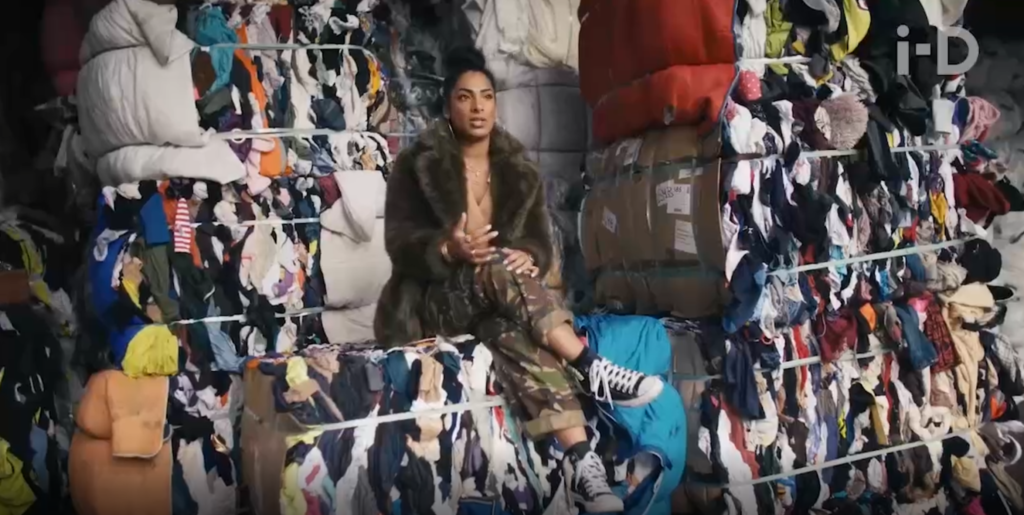
Write your answer:
Écris ta réponse :
- ✅ Correct!
- ❌ Try again
- ❌ Try again
- ❌ Try again
b. Watch the video and find information about fast fashion. b. Regarde la vidéo et trouve des informations sur la mode éphémère (fast fashion).
Copy the statements that are true according to the video.
Copie les phrases qui sont vraies selon la vidéo.
Click to check each one. Copy only those marked ✔ Correct.
- ✔ Correct
- ✔ Correct
- ✔ Correct
- ✘ Incorrect
- ✘ Incorrect
- ✔ Correct
- ✘ Incorrect
Sample answer
Fast fashion produces far too many garments and is a major polluter (second after oil). Everyone has a responsibility — from manufacturers to consumers — to act: buy smarter or kinder, care for and reuse what already exists, and make small personal changes now. You don’t have to be perfect; doing less harm and more good is what matters.
La fast fashion produit beaucoup trop de vêtements et est un grand pollueur (deuxième après le pétrole). Chacun a une responsabilité — des fabricants aux consommateurs — pour agir : acheter de manière plus responsable, prendre soin de ce qui existe déjà, réutiliser et commencer dès maintenant de petits changements. Pas besoin d’être parfait ; l’important est de faire moins de mal et plus de bien.
Script — Fast Fashion
Woman 1: No one is going to change the world by themselves. But if each person starts to make small changes, it’s like a revolution. The situation is bad. Fashion is currently the second biggest polluter of the planet after oil. Obviously, we’ve all got a part to play. From the manufacturers of fabrics to the consumer, there is responsibility to think about how you buy them and how you dispose of them and how you make them. All of that. I think it’s time for people to take action in their own lives. And if we could all make like little changes, no one has to be perfect. It really will make a massive impact on the planet. There’s no time like the present to get started. So you might have to start now.
Josephine Jones, designer: Fast fashion is the production of an unnecessarily large amount of garments. Fast fashion is out. It’s about looking after what we have, thinking about what already exists. You don’t have to give up your glamour to be sustainable. There are things that have already been made that we can continue to enjoy in a healthy way. Don’t buy less necessarily. Buy smarter or buy kinder. It literally sometimes is putting money where your mouth is. It’s not about being perfect. It’s just about being better, do less harm, do more good.
Doc 2
d. Take the document, read the text and find information about Tom Daley.
d. Prends le document et lis le texte pour trouver des informations sur Tom Daley.
Knitting helps Tom Daley switch off
Olympian Tom Daley is the most decorated diver in Britain’s history. He is also an avid knitter. At the Paris 2024 Olympics Daley added a fifth medal to his collection. He caught the world’s attention knitting a bright blue “Paris 24” jumper while travelling to the games and in the stands. At the Tokyo Olympics, where Daley was first spotted knitting, he explained its positive impact on his mental health. “It just turned into my mindfulness, my meditation, my calm and my way to escape the stresses of everyday life and, in particular, going to an Olympics.”
Olympics-level sport relies on perfect scores and world records. When it comes to knitting, many of the mental health benefits are associated with the process, rather than the end result. Daley says knitting is the “one thing” that allows him to switch off completely, describing it as “my therapy”.
Knitting’s been shown to have benefits relieving stress in high-pressure jobs beyond elite sport.
theconversation.com, 2024
Task: Select all the statements that are true according to the text.
Tâche : Sélectionne toutes les phrases vraies d’après le texte.
- ✔ Correct
- ✔ Correct
- ✔ Correct
- ✔ Correct
- ✘ Incorrect
- ✔ Correct
- ✘ Incorrect (the text emphasises medals and mental health, not records)
e. Written and oral production (Expression écrite et orale): Write a short paragraph (3–5 sentences) explaining why knitting can be beneficial, then be ready to read your answer aloud in front of the class.
e. Rédige un court paragraphe (3 à 5 phrases) expliquant pourquoi le tricot peut être bénéfique,
puis prépare-toi à lire ta réponse à voix haute devant la classe.
Sample answer
Knitting has many advantages. It helps people relax and reduce stress, especially in high-pressure situations. For Tom Daley, knitting is like therapy — it calms his mind and allows him to switch off after competitions. It’s also a creative activity that gives a feeling of satisfaction and mindfulness.
Le tricot présente de nombreux avantages. Il aide à se détendre et à réduire le stress, surtout dans les situations de forte pression. Pour Tom Daley, le tricot est comme une thérapie : cela apaise son esprit et lui permet de se déconnecter après les compétitions. C’est aussi une activité créative qui apporte une sensation de satisfaction et de pleine conscience.
Doc 1 and Doc 2
f. Compare the two approaches to fashion consumption and their advantages.
f. Compare les deux approches de la consommation de mode et leurs avantages.
Written and oral production (Expression écrite et orale): Write a short paragraph (4–6 sentences) comparing
the two documents (the video and the text), then prepare to present your answer orally to the class.
Rédige un court paragraphe (4 à 6 phrases) comparant les deux documents
(la vidéo et le texte), puis prépare-toi à présenter ta réponse à l’oral devant la classe.
Sample answer
In the video, people talk about making fashion more sustainable by buying smarter and producing less waste. They insist that small actions can help protect the planet. In the text about Tom Daley, knitting is also presented as a positive and creative activity that helps mental health. Both documents show that slow fashion and mindful activities can bring personal wellbeing and protect the environment.
Dans la vidéo, les personnes parlent de rendre la mode plus durable en achetant de manière plus responsable et en produisant moins de déchets. Elles insistent sur le fait que de petites actions peuvent aider à protéger la planète. Dans le texte sur Tom Daley, le tricot est aussi présenté comme une activité positive et créative qui aide à la santé mentale. Les deux documents montrent que la slow fashion et les activités conscientes apportent du bien-être personnel et protègent l’environnement.
Slow furniture
- Lecture : The Rise of Slow Furniture
- Compréhension du texte : le mouvement S.L.O.W. et ses valeurs (durabilité, éthique, production locale)
- Vocabulaire : environnement, artisanat, durabilité
- Culture : Slow Food & Slow Design Movements
- Activité interactive : Kahoot « The Rise of Slow Furniture » (15 questions)
Vocabulary Kit — Slow Furniture
- = changement
- = habitudes de consommation
- = socialement conscient
- = durabilité
- = pratiques éthiques
- = fait main
- = longévité
- = décharge
- = dégradation de l’environnement
- = pollution
- = effet boule de neige
- = marchand de bois
- = artisanat
- = sans âme
- = chaîne de production
- = respectueux de l’environnement
- = conception durable
- = design éthique
- = transport
- = artisan
Trucs et astuces — Culture Spot
The S.L.O.W. Movement began with the Slow Food Movement in 1986. It encourages people to focus on quality over quantity and to live more mindfully.
S.L.O.W. stands for Sustainable, Local, Organic, and Whole (not processed).
Le mouvement S.L.O.W. est né du mouvement Slow Food en 1986. Il encourage les gens à privilégier la qualité plutôt que la quantité et à vivre plus consciemment.
S.L.O.W. signifie Durable, Local, Biologique et Complet (non transformé).
Take the document The rise of slow furniture.
a. Look at the layout and identify the nature of the document.
a. Observe la mise en page et identifie la nature du document.
- ✅ Correct
- ❌ Try again
- ❌ Try again
- ❌ Try again
b. Read the first paragraph and identify the conclusions of the study.
b. Lis le premier paragraphe et identifie les conclusions de l’étude.
-
habits
There has been a clear shift in consumer shopping habits.
Il y a eu un changement net dans les habitudes d’achat des consommateurs.
-
conscious
Shoppers are more socially conscious.
Les acheteurs sont plus conscients des enjeux sociaux.
-
purchases
They are reducing the number of new purchases.
Ils réduisent le nombre de nouveaux achats.
-
choose
When they do buy new, they choose brands for their sustainability and ethical practices.
Lorsqu’ils achètent du neuf, ils choisissent des marques pour leur durabilité et leurs pratiques éthiques.
c. Read the subtitles and find the benefits of buying S.L.O.W. products.
c. Lis les sous-titres et trouve les avantages d’acheter des produits S.L.O.W.
-
Keep it green
Buying ‘slow’ products helps protect the environment and reduces waste.
Acheter des produits « lents » aide à protéger l’environnement et à réduire les déchets.
-
Keep it local
Buying locally supports local businesses and reduces pollution from transport.
Acheter localement soutient les entreprises locales et réduit la pollution due au transport.
d. Read the article and pay attention to repeated verbs and give the detailed arguments in favour of S.L.O.W. furniture.
d. Lis l’article et fais attention aux verbes répétés puis donne les arguments détaillés en faveur des meubles S.L.O.W.
Repeated verbs
buy, support, create, be
acheter, soutenir, créer, être
Suggested answer
Buying S.L.O.W. furniture has many advantages. It supports local businesses, helps the environment, and creates sustainable products that last longer. It’s also more ethical because the workers have good conditions and take pride in their craftsmanship.
Acheter des meubles S.L.O.W. présente de nombreux avantages. Cela soutient les entreprises locales, aide l’environnement et crée des produits durables qui durent plus longtemps. C’est aussi plus éthique car les travailleurs ont de bonnes conditions et sont fiers de leur savoir-faire.
The Rise of Slow Furniture: Why Sustainable and Ethical Design is the Future
From food to fashion and even furniture, there has been a noticeable shift in consumer shopping habits in the past few years. De l’alimentation à la mode et même au mobilier, on a constaté ces dernières années un changement notable dans les habitudes d’achat des consommateurs.
A study found that shoppers are more socially conscious — reducing the number of new purchases and, Une étude a montré que les acheteurs sont plus sensibles aux enjeux sociaux — ils réduisent le nombre de nouveaux achats
when they do buy new, are now more inclined to choose brands based on their sustainability and ethical practices. et, lorsqu’ils achètent du neuf, ils sont désormais plus enclins à choisir des marques selon leur durabilité et leurs pratiques éthiques.
Keeping It Green Préserver l’environnement
One of the primary benefits of buying ‘slow’ products is their minimal impact on the environment. L’un des principaux avantages d’acheter des produits « slow » est leur impact minimal sur l’environnement.
Handcrafted furniture is designed to last for generations, unlike mass-produced furniture which is not made with longevity in mind. Les meubles faits à la main sont conçus pour durer des générations, contrairement aux meubles produits en masse qui ne sont pas pensés pour la longévité.
Fast furniture often ends up in landfills, contributing to environmental degradation. Le mobilier « fast » finit souvent en décharge, ce qui contribue à la dégradation de l’environnement.
Keeping It Local Privilégier le local
Buying locally-made furniture is also better for the environment, eliminating pollution caused by transportation. Acheter des meubles fabriqués localement est aussi meilleur pour l’environnement, car cela élimine la pollution liée au transport.
Buying local has a more profound impact on the economy. Acheter local a un impact plus profond sur l’économie.
Supporting local creates a ripple effect as fellow businesses in the area also benefit, from gift shops selling handcrafted items to timber merchants selling wood. Soutenir le local crée un effet d’entraînement, d’autres entreprises de la zone en profitant également, des boutiques de cadeaux vendant des objets artisanaux aux marchands de bois.
Moreover, by buying locally, you can be certain of the working conditions the furniture is produced in. De plus, en achetant localement, vous pouvez être certain des conditions de travail dans lesquelles le mobilier est produit.
You can be certain that the piece you have bought was created with care by a maker passionate about their craft — as opposed to one made on a soulless and potentially dangerous factory line. Vous pouvez être certain que la pièce achetée a été créée avec soin par un artisan passionné par son métier — par opposition à un article fabriqué sur une chaîne industrielle sans âme et potentiellement dangereuse.
Source: chippendaleschool.com, 2023 Source : chippendaleschool.com, 2023
Final Task
Final Task — Sustainable Project Contest
Work in groups of 2–3. Enter a school contest for the most sustainable project!
Travaillez en groupes de 2–3. Participez à un concours pour le projet le plus durable !
- Choose a sustainable project from this page: fashion or making furniture.
Choisis un projet durable : la mode ou la fabrication de meubles. - Imagine a slogan and write a short text. Say why your project is the most ethical and sustainable.
Imagine un slogan et rédige un court texte. Explique pourquoi ton projet est le plus éthique et durable. - Create a digital poster to promote it and be ready to present orally (expression orale, marked).
Crée une affiche numérique pour le promouvoir et prépare une présentation orale (évaluée). - Think how your fashion or furniture project could be integrated into your school (clubs, events, sourcing, recycling, makerspace…).
Réfléchis à la façon d’intégrer ton projet de mode ou de mobilier dans le collège (clubs, événements, collecte, recyclage, atelier…).
Language to use:
• Present perfect to state a situation: “There has been a noticeable shift in consumer shopping habits.”
• Superlatives & comparatives: “Fashion is currently the second biggest polluter of the planet.” / “Shoppers are more socially conscious.”
Langue à utiliser : present perfect, superlatifs et comparatifs.
Marking criteria: correct use of present perfect, comparatives & superlatives, and clear pronunciation in the oral presentation.
Critères d’évaluation : usage correct du present perfect, des comparatifs et superlatifs, et prononciation claire à l’oral.