
Predictions & 911
Information
- Texte : Three Cliffhangers — trois fins de chapitre célèbres.
- Image : What's Behind the Hedge? — un homme stupéfait devant une haie.
- Image : You Are All Alone… — une femme terrifiée.
- Audio : …and You Hear THIS — des bruits inquiétants, sans paroles.
- Séance 1 : Words & Grammar
- Séance 2 : Keep Calm… and Call 911!
- Séance 3 : Évaluation
Séance 1 : Words & Grammar
- Objectif : Apprendre le lexique de la fiction, parler de l'avenir avec BE going to et faire des hypothèses avec may, might et must.
- Activités : Lexique de la fiction ; synonymes et spoilers ; anagrammes d'expressions ; mots à compléter ; critique de roman à compléter ; kit de grammaire BE going to ; intention ou prédiction ; mes intentions pour le week-end ; trois fins de chapitre ; prédire la suite ; kit de grammaire may, might, must ; possible ou presque certain ; mes hypothèses ; l'illustration de la haie ; qu'y a-t-il derrière la haie ; going to prononcé gonna ; atelier de traduction.
- À retenir : Savoir dire ce que l'on va faire (I'm going to… / I'm not going to…), prédire à partir d'indices (I think … is going to…) et faire une hypothèse possible (may, might) ou presque certaine (must) + infinitif.
Vocabulary Kit: Around Fiction
- a television series = une série télévisée
- an episode = un épisode
- the audience = le public, les spectateurs
- the script-writer = le/la scénariste
- a novel = un roman
- a chapter = un chapitre
- the reader = le lecteur, la lectrice
- the writer, the author = l'écrivain, l'auteur(e)
Comprehension: Say It Another Way
Anagrams: Put the Expressions Back Together
Remets les lettres dans l'ordre pour reconstituer l'expression.
Complete the text: Words About Fiction
1. _ p _ s _ _ _ → episode · 2. a _ _ _ e n _ _ → audience · 3. n _ _ e _ → novel · 4. c _ a _ _ _ r → chapter · 5. w _ i _ e _ → writer · 6. a _ _ _ o _ → author
Complete the text: A Book Review
In R. L. Stine’s new novel called A Night in Terror Tower, he creates a lot of suspense as always and he keeps readers interested with plenty of twists and turns and cliffhangers! We won’t give the ending away because no-one likes a spoiler but we can tell you that there are some shocking revelations and some characters may find themselves in a life-threatening situation!
Grammar Kit: BE going to — intention et prédiction
Pour renvoyer à l'avenir, on peut utiliser la structure : sujet + BE conjugué au présent + going to + infinitif.
I am going to tell you something.
Je vais te dire quelque chose.
Maybe they are going to get locked in the Terror Tower.
Ils vont peut-être se retrouver enfermés dans la Terror Tower.
Maybe Sue is going to lose her camera!
Sue va peut-être perdre son appareil photo !
Pour dire que l'on ne va pas faire quelque chose, il suffit d'ajouter not entre l'auxiliaire BE et going to.
I'm not going to spoil the end of the story for you though!
Mais je ne vais pas te gâcher la fin de l'histoire !
On peut utiliser BE going to pour :
- exprimer ses intentions (exemple 1) ;
- faire une prédiction à partir d'indices présents (exemples 2 et 3).
I'm going to read the rest of the story to find out more!
Je vais lire la suite de l'histoire pour en savoir plus ! — une intention
I think Eddie is going to die.
Je pense qu'Eddie va mourir. — une prédiction
Choose the right option: Intention or Prediction?
- a. “I’m going to read the rest of the story to find out more!” (an intention/a prediction)
- b. “I think Eddie is going to die.” (an intention/a prediction)
- c. “I’m not going to spoil the end of the story for you though!” (an intention/a prediction)
Writing Task: Your Weekend Intentions
2. Write two things you are not going to do.
2. Écris deux choses que tu n'as pas l'intention de faire.
Document: Three Cliffhangers
Three Cliffhangers
Chapter ending 1
Harry Potter and the Deathly Hallows, J. K. Rowling, 2009
Chapter ending 2
R. L. Stine’s Twitter story, 2012
Chapter ending 3
The Chronicles of Narnia: The Magician’s Nephew, C. S. Lewis, 1955
Writing Task: What Is Going to Happen Next?
2. For each one, write what you think is going to happen next.
2. Pour chacun, écris ce qui va se passer d'après toi.
Grammar Kit: May, might, must — l'hypothèse
Avec les modaux may, might et must, on fait des hypothèses. Structure : modal + infinitif. La conjugaison du modal ne change pas selon la personne.
It may be a “false alarm” cliffhanger because the writer is famous for it!
C’est peut-être un cliffhanger « fausse alerte », car l’auteur est célèbre pour ça !
People say the tower might be haunted, but I can’t believe it.
On dit que la tour est peut-être hantée, mais je n’arrive pas à le croire.
It must be terrifying to get locked in the Tower of London for a whole night.
Ça doit être terrifiant d’être enfermé dans la Tour de Londres toute une nuit.
- Avec may et might, quelque chose est possible mais pas sûr : il y a toujours des vérifications à faire (exemples 1 et 2).
- Avec must, l'hypothèse nous semble très probable, presque certaine (exemple 3).
Malgré une légère différence, le plus souvent on utilise may et might comme des synonymes.
Choose the right option: Possible or Almost Certain?
- a. “Someone must be in the house because I can hear them!” (possible/almost certain)
- b. “It may be a burglary!” (possible/almost certain)
- c. “I don’t know what they want. They might want to hurt me!” (possible/almost certain)
Comprehension: Make Your Hypotheses
Document: What's Behind the Hedge?
A man is trimming a hedge. Look at his face.
Un homme taille une haie. Regarde son visage.
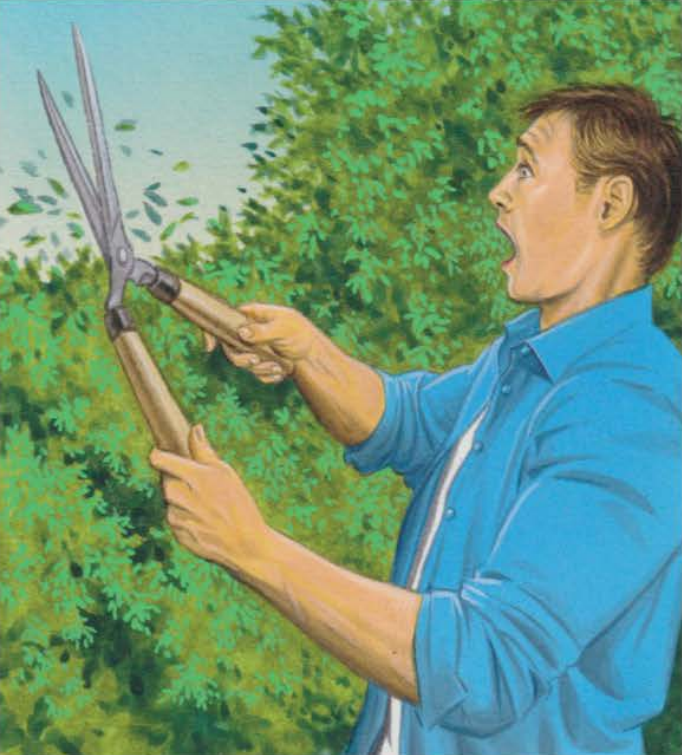
Writing Task: What's Behind the Hedge?
2. Then explain what is going to happen next.
2. Puis explique ce qui va se passer.
Sentence Generator: going to → gonna
Translation Task: Words & Grammar
Séance 2 : Keep Calm… and Call 911!
- Objectif : Tâche finale : prendre part à une conversation téléphonique d'urgence et la terminer sur un cliffhanger.
- Activités : Photo d'une femme terrifiée ; bruitages à écouter les yeux fermés ; liste des bruits entendus ; Mini Project : l'appel au 911 ; jeu des serpents et échelles sur les modaux et le futur ; anagrammes de verbes irréguliers ; bilan Lire et comprendre ; atelier de traduction.
- À retenir : Savoir décrire ce que l'on entend, faire des hypothèses (There might be… / They must be…), rassurer et aider (Keep calm, I'm going to help you) et finir une scène sur un suspense.
Document: You Are All Alone…
You are all alone somewhere and you hear… THIS.
Tu es tout(e) seul(e) quelque part et tu entends… CECI.

Document: …and You Hear THIS
Turn off the lights, close your eyes and listen.
Éteins la lumière, ferme les yeux et écoute.
Comprehension: What Can You Hear?
Mini Project: Hello, 911. What's Your Emergency?
2. Pupil 2: you are the 911 operator. Take the call.
3. Use may, might, must and BE going to.
4. End on a cliffhanger!
5. Act out your call, or record it at home over the sound effects. The class votes: the scariest, the most convincing, the most suspenseful.
2. Élève 2 : tu es l'opérateur du 911. Prends l'appel.
3. Utilise may, might, must et BE going to.
4. Termine sur un cliffhanger !
5. Jouez votre appel, ou enregistrez-le à la maison sur les bruitages. La classe vote : le plus effrayant, le plus convaincant, celui qui tient le plus en haleine.
Pupil 2: Hello, 911. What’s your emergency?
Pupil 1: Hello, I need help! I can hear someone. I think there might be a burglar in my house.
Pupil 2: Ok, try to keep calm. I’m going to help you. Where do you live?
Pupil 1: I live at 24 Castle Street in Oxford. Please come quickly.
Pupil 2: Ok, we are sending someone to your house. Can you explain what you can hear?
Pupil 1: I heard someone walking downstairs. They must be in the house. I’m scared!
Pupil 2: Try to remain calm. Go hide somewhere until the police come. I will stay on the phone with you.
Pupil 1: Now someone is opening a door…
Pupil 2: Right… Don’t you think it could be your parents?
Pupil 1: Er… I don’t know…
Pupil 2: Or an animal…?
Game: Modals and the Future
Anagrams: Irregular Verbs
Remets les lettres dans l’ordre pour retrouver les trois formes du verbe : infinitif, prétérit, participe passé.
Quelques conseils avant de lire un document : tu disposeras souvent d'un titre ou d'une image ; visualise des mots anglais que tu as lus récemment sur ce sujet ; et prépare-toi à lire en te disant que tu vas comprendre des choses.
Colour the circle that matches how you feel about each goal.Colorie le cercle qui correspond à ce que tu sais faire pour chaque objectif.
| I can… / Je sais… | Acquis |
En cours |
À travailler |
|---|---|---|---|
| I can use the clues beside the text: the visual context — the pictures or illustrations that come with the document.Utiliser les indices à côté du texte : le contexte visuel (images ou illustrations accompagnant le document). | |||
| I can use the clues beside the text: the source of the document — its title, its author, the date it was published.Utiliser les indices à côté du texte : la source du document (le titre, l'auteur, la date de publication…). | |||
| I can use the clues inside the text: the capital letters — do they mark a proper noun, and of what kind?Utiliser les indices contenus dans le texte : les majuscules — indiquent-elles un nom propre ? de quelle nature (lieu, personne…) ? ou s'agit-il d'un nom de jour, de mois, d'une nationalité… ? | |||
| I can use the clues inside the text: the repetitions.Utiliser les indices contenus dans le texte : les répétitions. | |||
| I can use the clues inside the text: the first sentence of each paragraph, which often announces or sums up what the paragraph says.Utiliser les indices contenus dans le texte : la première phrase de chaque paragraphe : elle annonce ou résume souvent le contenu du paragraphe. |
Translation Task: Keep Calm… and Call 911!
Évaluation : Connaissances et verbes irréguliers
- Type d'évaluation : QCM de connaissances (écrit) + interrogation orale de verbes irréguliers
- Axe : Axe 5 — Langages et messages artistiques
- Compétences : Connaissances lexicales, grammaticales et culturelles — A2 / A2+ ; verbes irréguliers : Bande 2 (verbes 1 à 25)
- Coefficient : 1 pour le QCM · 1 pour les verbes