Séance 1 : Look at Me!

  • Objectif : Comprendre un 2e extrait de The Cat in the Hat et nommer les objets ; réviser CAN.
  • Activités : Lecture de l’extrait « Look at me! », lecture animée, association mots/objets, avis sur le passage, lexique des loisirs, critique de livre, traduction.
  • À retenir : Savoir nommer les objets, dire ce que le chat peut faire (CAN) et donner son avis sur un texte.

Document: The Cat in the Hat

The Cat in the Hat
— Part 2: Look at Me! —
_____ _____
_____ _____
_____ _____
_____ _____
_____ _____
_____ _____
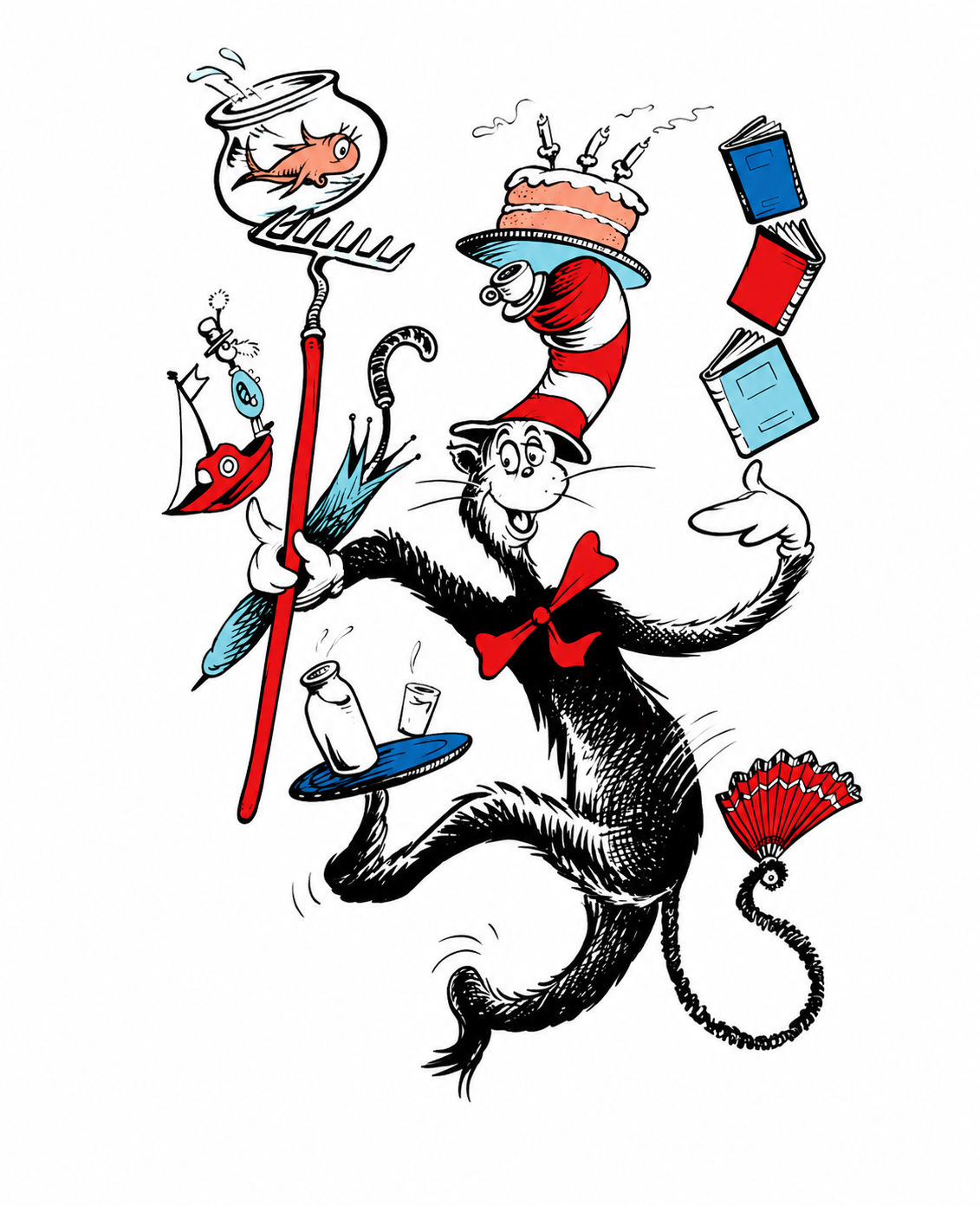
The Cat balancing his objects
I can hold up the cup
and the milk and the cake!

I can hold up these books!
And the fish on a rake!

I can hold the toy ship
and a little toy man!

And look! With my tail
I can hold a red fan!
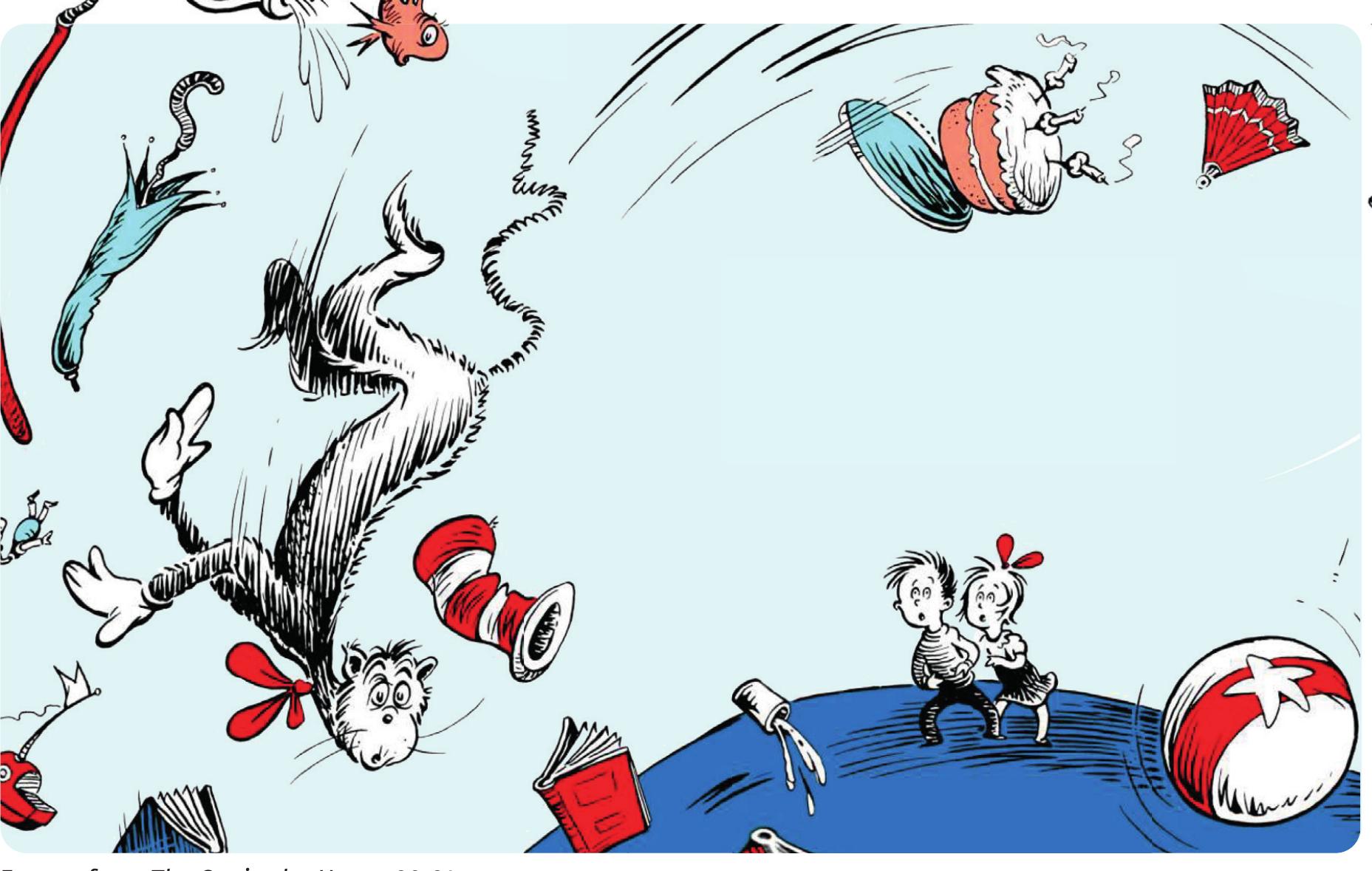

The Cat falling on his head
That is what the cat said…
Then he fell on his head!

The Cat in the Hat — by Dr. Seuss (1957)

Document: Look at Me! (read-along)

The Cat in the Hat shows off — listen and read along as he holds up more and more objects.

Le Cat in the Hat fait le malin — écoute et lis en même temps qu'il tient de plus en plus d'objets.

Script
_____ _____ _____
_____ _____
_____ _____
_____ _____
_____ _____
_____ _____
The Cat in the Hat
I can hold up the cup and the milk and the cake!
I can hold up these books! And the fish on a rake!
I can hold the toy ship and a little toy man!
And look! With my tail I can hold a red fan!
That is what the cat said…
Then he fell on his head!

Match: The Cat’s Objects

Match each word to its picture.
Associe chaque mot à son image.

Speaking: Did You Like It?

You have read the whole extract. What do you think of it?
Tu as lu tout l’extrait. Qu’en penses-tu ?
Did you like this passage? Why or why not?
As-tu aimé ce passage ? Pourquoi ?
What is your favourite line?
Quelle est ta réplique préférée ?
Would you like to meet the Cat in the Hat? Why?
Aimerais-tu rencontrer le Cat in the Hat ? Pourquoi ?

Vocabulary Kit: Free Time & Games

Free time & games
  • have fun = s'amuser
  • hang out = traîner, passer du temps
  • be bored = s'ennuyer
  • do nothing = ne rien faire
  • stay inside = rester à l'intérieur
  • go outside = sortir (dehors)
  • draw = dessiner
  • paint = peindre
  • play board games = jouer à des jeux de société
  • play ball = jouer au ballon
  • do some tricks = faire des tours
  • act silly = faire l'idiot
  • jump = sauter
  • fall = tomber
  • hold = tenir
  • look (at) = regarder
  • see = voir
  • go away = s'en aller, partir
  • pick up = ramasser
  • drop = faire tomber, lâcher
  • spend time + V-ing = passer du temps à (faire)

Complete the text: A Book Review

Complete the book review with the right words.
Complète la critique du livre avec les bons mots.

The book is called The Cat in the Hat. The writer is Dr. Seuss. The main character is a cat! My favourite lines are "I know it is wet and the sun is not sunny, but we can have lots of good fun that is funny." I like the way he uses rhymes like "sunny" and "funny".

Translation Task: Look at Me!

Build the sentence in English
Clique sur une flèche pour lancer la roulette.

Séance 2 : Sounds & Rhythm

  • Objectif : Réactiver CAN ; travailler l’accent de mot et les diphtongues.
  • Activités : Réactivation de CAN, leçon sur l’accent de mot et les diphtongues, écoute et classement de sons, jeux d’écoute, mots croisés, traduction.
  • À retenir : Savoir employer CAN et reconnaître l’accent de mot et les diphtongues de l’anglais.

Grammar Kit: CAN (réactivation)

CAN / CAN'T

CAN exprime la capacité : savoir ou pouvoir faire quelque chose. Il est invariable.

  • Affirmatif : I can hold the cup.
  • Négatif : I can't (cannot) swim.

The cat can hold a red fan!

Le chat peut tenir un éventail rouge !

La forme
  • CAN + base verbale (sans to) : He can jump.
  • Pas de -s à la 3e personne : She can (pas cans).
  • Question : Can you…? → Yes, I can. / No, I can't.

Can you hold these books? Yes, I can!

Peux-tu tenir ces livres ? Oui, je peux !

Grammar Kit: L'accent de mot & les diphtongues

L'accent de mot

Dans un mot anglais de plusieurs syllabes, une syllabe est accentuée (dite plus fort et plus longtemps).

  • IN·side · sur·PRISED · FRIEND·ly
  • PLAY·ful · NO·thing · en·TER·tai·ning
  • Astuce : tape dans tes mains sur la syllabe accentuée.
Les 8 diphtongues

Une diphtongue est un son formé de deux voyelles : la voix glisse de l'une à l'autre.

  • /aɪ/ — like, smile
  • /eɪ/ — cake, day
  • /ɔɪ/ — boy, toy
  • /aʊ/ — house, now
  • /əʊ/ — go, hold
  • /eə/ — there, hair
  • /ɪə/ — here, near
  • /ʊə/ — sure, tourist

I like to play outside.

J'aime jouer dehors.

The boy holds a toy.

Le garçon tient un jouet.

Document: The Diphthong Game

A listening game with eight words, one for each diphthong: /eɪ/, /eə/, /aɪ/, /ɪə/, /aʊ/, /ɔɪ/, /əʊ/, /ʊə/.

Un jeu d’écoute avec huit mots, un pour chaque diphtongue : /eɪ/, /eə/, /aɪ/, /ɪə/, /aʊ/, /ɔɪ/, /əʊ/, /ʊə/.

Script
_____ _____ _____ _____ _____ _____ _____ _____
Narrator
caketherewhitenearhowboynosure

Sounds: Sort the Diphthongs

Sort these words by the diphthong sound you hear.
Classe ces mots selon la diphtongue que tu entends.
/aɪ/
/eɪ/
/ɔɪ/

Document: The Cat’s Strange Day

A short, silly poem about one very strange day in the life of the Cat in the Hat.

Un petit poème loufoque sur une journée très étrange du Cat in the Hat.

Script
_____ _____ _____
_____ _____
_____ _____
_____ _____
_____ _____
Narrator
Cat in the Hat has had a very strange day!
He painted his face to look like a clown
Then fell in a hole deep in the ground.
He held a small dragon down there in the dark.
Then flew out of the hole to go to the park.

Listen Up: The Cat’s Strange Day

Listen again. What did the Cat in the Hat do on his strange day?
Réécoute. Qu’a fait le Cat in the Hat pendant sa journée étrange ?
Did he paint his face?
A-t-il peint son visage ?
Did he fall?
Est-il tombé ?
What did he hold?
Qu’a-t-il tenu ?

Document: The Riddle

A short riddle about a garden tool. Listen carefully — the answer is the password for next class!

Une petite devinette sur un outil de jardin. Écoute bien — la réponse est le mot de passe du prochain cours !

Script
_____ _____
_____ _____
_____ _____
_____
Narrator
I help you in the garden.
I have many teeth, but I don’t bite.
I move leaves and grass.
What am I?

Crossword: Dr. Seuss & Free Time

Expression mystère :
→ Across
1.To push off the ground with both feet.
2.Very happy and full of joy.
3.Strange, unusual and a bit odd.
4.Funny in a foolish, playful way.
5.Full of fun and games; loving to play.
6.The regular beat you feel in a poem.
↓ Down
1.A game or problem you solve.
2.To drop down suddenly to the ground.
3.Wild, mad and a little bit wacky.
4.When two words end with the same sound.
5.A person who writes books, like Dr. Seuss.
6.To keep something in your hands.

Translation Task: Two-Vowel Sounds

Build the sentence in English
Clique sur une flèche pour lancer la roulette.

Séance 3 : Final Task: New Adventures!

  • Objectif : Écrire et raconter de nouvelles aventures pour le Cat in the Hat (tâche finale).
  • Activités : Création en groupe d'une courte scène rimée, illustration, mise en voix et présentation à la classe, auto-évaluation.
  • À retenir : Savoir écrire un court texte rimé en s'inspirant d'un modèle et le présenter à l'oral.

Speaking: Chain Reading & Memory

The task
In teams, take on two challenges! 1) Chain reading: read the extract line by line, one after another, keeping the rhythm. 2) Memory game: without looking, name all the objects the Cat can hold.
En équipes, relevez deux défis ! 1) Lecture en chaîne : lisez l'extrait ligne par ligne, l'un après l'autre, en gardant le rythme. 2) Jeu de mémoire : sans regarder, nommez tous les objets que le chat peut tenir.
Speak only — use key words from your notes, not full sentences.
Parlez seulement — utilisez des mots-clés de vos notes, pas des phrases entières.
en équipes
Hints
Chain reading +
Read one line each, then pass to the next person. Keep the beat — snap your fingers!
Keep the rhythm +
Say the rhyming words clearly: cake / rake, cup / up, man / fan.
Memory game +
Remember: the cup, the milk, the cake, the books, the fish, the toy ship, the toy man, the red fan.
Useful sentence +
Use: “The Cat can hold the ___ !”
Grille d'évaluation — présentation orale
Marking guide — oral presentation
… / 20
Content
Reads the extract in rhythm and names the Cat’s objects.
… / 5Contenu
Language
“The Cat can hold…” + object words.
… / 5Langue
Fluency
Reads smoothly, in rhythm, without stopping.
… / 5Aisance
Accuracy
Object words are said correctly.
… / 5Correction
Mes notes de préparation

Speaking: Invent New Challenges

The task
Invent new challenges for the Cat in the Hat! Think of funny new objects he could hold, and say them with the model: “I can hold the ___ and the ___!”. The sillier, the better!
Invente de nouveaux défis pour le Cat in the Hat ! Pense à de nouveaux objets drôles qu'il pourrait tenir, et dis-les avec le modèle : « I can hold the ___ and the ___! ». Plus c'est absurde, mieux c'est !
Speak only — use key words from your notes, not full sentences.
Parlez seulement — utilisez des mots-clés de vos notes, pas des phrases entières.
environ 2 minutes
Hints
The model +
Use: “I can hold the ___ and the ___!”
Funny objects +
a pizza, a cactus, a chair, a phone, a cat, a hat…
Make it rhyme +
Try rhyming pairs: a cat / a hat, a spoon / a balloon, a chair / a bear.
Add your tail! +
Say: “And look! With my tail I can hold a ___!”
Grille d'évaluation — présentation orale
Marking guide — oral presentation
… / 20
Content
Invents new, funny objects for the Cat to hold.
… / 5Contenu
Language
“I can hold the ___ and the ___!” used correctly.
… / 5Langue
Fluency
Says the challenges with rhythm and energy.
… / 5Aisance
Accuracy
Object words are correct and clear.
… / 5Correction
Mes notes de préparation

Final Task: Write New Adventures!

The task
Write and tell new adventures for the Cat in the Hat!
1. Create a new character with a rhyming name (The ___ in the ___).
2. Invent new challenges: “I can hold the ___ and the ___!”.
3. Read your rhyming story to the class.
Écris et raconte de nouvelles aventures pour le Cat in the Hat !
1. Crée un nouveau personnage avec un nom qui rime (The ___ in the ___).
2. Invente de nouveaux défis : « I can hold the ___ and the ___! ».
3. Lis ton histoire rimée à la classe.
40 – 60 mots
Hints
Your character +
Give it a rhyming name: The Frog in the Log, The Bee in the Tree…
New challenges +
Use “I can hold the ___ and the ___!” with funny objects.
Make it rhyme +
cup / up, cake / rake, ship / trip, fun / sun…
Read it aloud +
Say your lines with rhythm — snap your fingers to keep the beat!
Grille d'évaluation — production écrite
Marking guide — written task
… / 20
Content
Invents a character and new rhyming challenges.
… / 5Contenu
Language
Uses “I can hold…” and “The ___ in the ___” with rhymes.
… / 5Langue
Fluency
40–60 words; the lines rhyme and have rhythm.
… / 5Aisance
Accuracy
Sentences are correct; the rhyming words are well chosen.
… / 5Correction
Your ideas
Bilan : The Fantastic World of Dr. Seuss

Colour the circle that matches how you feel about each goal.Colorie le cercle qui correspond à ce que tu sais faire pour chaque objectif.

I can… / Je sais…
Acquis
En cours
À travailler
…talk about my favourite book or character.…parler de mon livre ou de mon personnage préféré.
…understand teenagers talking about Dr. Seuss (Sarah and Max).…comprendre des adolescents qui parlent de Dr. Seuss (Sarah et Max).
…understand extracts from The Cat in the Hat.…comprendre des extraits de The Cat in the Hat.
…use the past simple with irregular verbs (came, saw, held, fell…).…utiliser le prétérit avec les verbes irréguliers (came, saw, held, fell…).
…use CAN to say what someone can do.…utiliser CAN pour dire ce que quelqu'un peut faire.
…read a rhyming text aloud with rhythm and the right sounds.…lire un texte rimé à voix haute, en rythme et avec les bons sons.
…invent and write new adventures for the Cat in the Hat (final task).…inventer et écrire de nouvelles aventures pour le Cat in the Hat (tâche finale).

Évaluation : Compréhension écrite + Prononciation

  • Type d'évaluation : QCM
  • Axe : Axe 4 — Imaginaire, contes et légendes
  • Compétences : A1-A2 — Compréhension écrite (poème) et prononciation (accent, diphtongues)
  • Coefficient : 1
Nom, Prenom :
Classe :
Date :
Note :
Axe : Imaginaire, contes et légendes
CECRL : A1-A2
Activité langagière : Compréhension de l'écrit
Compétence : Comprendre un poème (tâche de transfert)
ÉVALUATION — I Didn’t Go Camping Compréhension de l'oral
Compréhension de l’écrit Read the poem, then answer.
I Didn’t Go Camping
I didn’t go camping.
I didn’t go hiking.
I didn’t go fishing.
I didn’t go biking.
I didn’t go play
on the slides at the park.
I didn’t watch shooting stars
way after dark.
I didn’t play baseball
or soccer outside.
I didn’t go on an
amusement park ride. […]
I didn’t go swimming
at pools or beaches,
or visit an orchard
and pick a few peaches.
I didn’t become
a guitarist or drummer,
but, boy, I played plenty
of Minecraft this summer.
— Kenn Nesbitt
1.
Quel genre de texte est-ce ? Comment le sais-tu ? / 4
Correction : C’est un poème : vers courts, rimes (camping/biking…) et la répétition de « I didn’t go… ».
2.
Quelle structure se répète tout au long du texte ? / 4
Correction : La forme négative du prétérit : « I didn’t… » (I did not…).
3.
Cite deux choses que l’auteur n’a PAS faites cet été. / 4
Correction : Il n’est pas allé camper / faire du vélo / nager / au parc d’attractions (deux exemples suffisent).
4.
Qu’a-t-il fait, finalement, pendant l’été ? / 4
Correction : Il a joué à Minecraft (« I played plenty of Minecraft this summer »).
5.
Que penses-tu de ce texte : amusant, effrayant ou triste ? Justifie. / 4
Correction : Réponse libre : amusant / drôle, par exemple parce que la chute sur Minecraft est surprenante.
Nom, Prenom :
Classe :
Date :
Note :
Axe : Imaginaire, contes et légendes — The Cat in the Hat
CECRL : A1
Activité langagière : Prononciation
Compétence : L'accent de mot et les diphtongues
EVALUATION — Prononciation Questions à choix unique
1.
Where is the stress in “friendly”?
2.
Where is the stress in “surprised”?
3.
Where is the stress in “playful”?
4.
Which diphthong is in “like”?
5.
Which diphthong is in “cake”?
6.
Which diphthong is in “boy”?
7.
Which diphthong is in “house”?
8.
Which diphthong is in “go”?
9.
Which word contains a diphthong?
10.
Which word does NOT contain a diphthong?